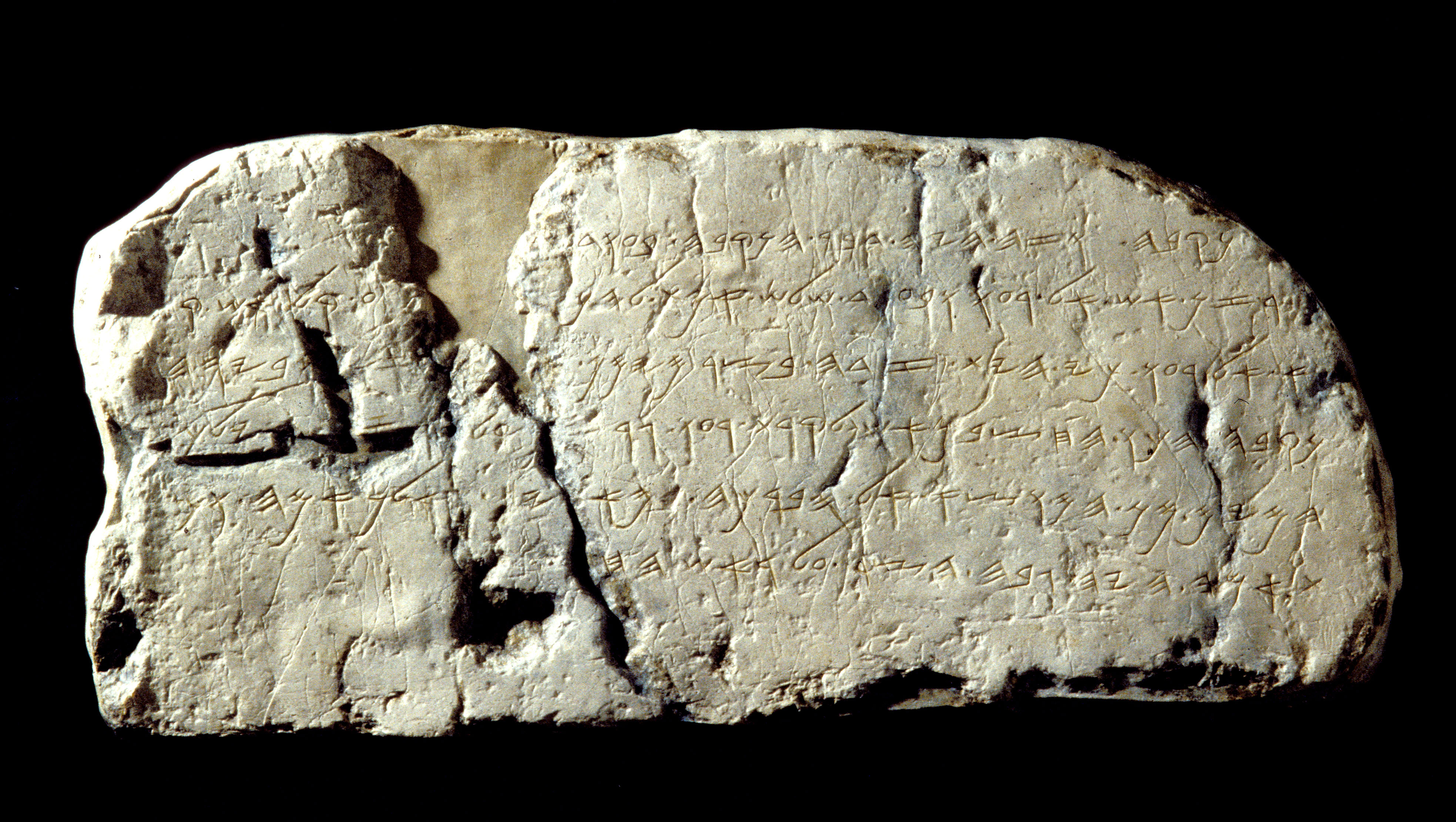

The text carved on the wall of the Siloam tunnel in Jerusalem is thought to be a watershed in the history of Hebrew prose because it signals a “deictic shift” in West Semitic inscriptions “from the king to the message itself” and gives credit for this engineering marvel to the ordinary people who labored to achieve it.1 This late eighth-century BCE inscription (KAI 189) commemorates the moment when two groups of workmen, tunneling through the rock from either end, met in the middle and the water began to flow. Because of its dramatic sense of immediacy, it is often understood to have been written by, or at least reflect the perspectives of, the workmen and constitute something like an elaborate graffito.2 Yet the advent of multimodality in the study of West Semitic epigraphy has shown that we cannot understand the meaning of an inscription based solely on its linguistic content, because “the visual and spatial modes of such writings” play a role in shaping the message.3 The time is ripe for a new reading of the Siloam tunnel inscription, one that offers a more robust account of its location, its material features, and the character and quality of its workmanship.
I want to show you why the Siloam tunnel inscription is not the departure from the tradition of West Semitic royal inscriptions it is typically thought to be. Vernacular prose is now widely thought to have emerged in the ninth century BCE as kings mimicked Assyrian genres in local scripts and idioms in order to assert their power locally yet “walk a fine line…between the domestic and the imperial.”4 Within this regional development, as William Schniedewind has noted, each inscription reflects “the idiosyncracies of individual scribes, unique social locations and historical circumstances,” and the Siloam tunnel inscription is no exception.5 Like typical West Semitic royal inscriptions, it mimics an Assyrian genre, but it does so in a distinctive way. Assyrian kings have a long history of commemorating access to and mastery over water sources by incorporating inscriptions into the landscape. A multimodal reading of the Siloam tunnel inscription suggests that the scribe responsible for it subverted the norms of this genre in an effort to ensure Judah’s survival as an independent state.
A Problem of Genre
The Siloam tunnel inscription is carved in stone and directly associated with a massive hydraulic engineering project undertaken with royal sponsorship as part of a set of transformations to the urban landscape of Jerusalem. In this sense, it is consistent with West Semitic royal inscriptions, which tend to commemorate domestic building activity in lieu of emphasizing military achievements.6
Its script is also the practiced and elegant cursive of a highly trained scribe, who may have written administrative texts and letters on a daily basis and perhaps even on occasion literature, especially if that literature served the interests of the state.7 As the featured image at the top of this article illustrates, the text is horizontal, the characters are well spaced, and the letterforms, although carved into stone, exhibit ticks where the pen would be lifted when writing with ink on papyrus.8
Its cursive character might once have been a problem for the idea that it is a royal inscription, because we used to assume that royal inscriptions are written in lapidary script, while cursive is saved for administrative or private contexts. Yet recent scholarship has shown this to be a false distinction.9 Script choice is shaped by a variety of factors, including medium, tools, and even aesthetic considerations. An inscription written on basalt, for example, had to be executed with chisels, and this work may have been done by a mason, who had this technical expertise even if he had no formal scribal training. Limestone, which is much softer, could be etched, a technology that is more amenable to cursive—and more easily adopted by a scribe accustomed to writing on papyrus, should he have been inclined to undertake the work himself rather than collaborate with another craftsman. Still, even inscriptions on basalt involve elements of cursive, some more than others, which illustrates how script is ultimately the decision of a given craftsman in a given situation.10 It would be wrong to draw a categorical distinction between the inscription in the Siloam tunnel and, say, the fragmentary inscriptions from the Ophel and the City of David, whose scripts lean toward a lapidary style. Indeed, all of these inscriptions are commonly thought to have been written by scribes with the same training, if not by the same person.11
While its cursive script may not be an issue, the content of the Siloam tunnel inscription does not seem to have been commissioned by an elite individual, and this is problematic. If it is a royal inscription, the king is strangely absent. We might expect it to start with ʾnk.ḥzqyhw.bn.ʾḥz, “I am Hezekiah son of Ahaz,” analogous to ʾnk.klmw.br.ḥy, “I am Kulamuwa son of Hayya” (KAI 24) or ʾnk.mšʿ.bn.kmš[yt], “I am Mesha son of Kemosh[yat]” (KAI 181), and continue with a narration of his deeds that, like these other West Semitic royal inscriptions, focuses on his domestic accomplishments and how his reign is superior to that of his predecessors. Such texts typically laud the king as the agent of a particular deity or as acting with the support or aid of the Assyrian king.12
What we get instead is [zt].hnqbh, “this is the tunnel,” and a narration of how the workmen completed it. This beginning fits better with the “old alphabetic dedicatory tradition of deictically marking artifacts” than it does with royal inscriptions.13 The influence of that tradition is occasionally felt in West Semitic royal inscriptions, notably in the Aramaic version of the Tel Fekherye inscription (KAI 309), which begins with dmwtʾ.zy.hdysʿy, “This is the image of Hadad-yithʿi,” although that text continues to focus on the king, as usual. The Siloam tunnel inscription’s focus on the labor crew is truly distinctive.
So it is understandable that we have assessed the Siloam tunnel inscription as an in-the-moment expression of excitement and pride on the part of ordinary laborers. This interpretation is based largely on its content. Yet a multimodal reading presses us to give at least equal weight to its material features. Multimodality studies recognize that some modes of an inscription are more prominent than others and may shape how the others are interpreted.14 The first thing a viewer of the Siloam tunnel inscription in situ would notice about it is not its content but its design—the character of its script and layout, the slightly recessed panel that contains the text, the empty space in the top half of the panel (Figure 1)—and, perhaps most importantly, the fact that it marks the significant engineering project in which they are currently standing, which would have been possible only with royal patronage. These are the very modes that would lead one to assess it as a royal inscription.

This does not mean that we should dismiss its content. But it does mean that we need to ask a different set of questions about that content, questions related to genre. Genre involves material, social, and rhetorical elements of a text as well as formal ones, and assessing the genre of a text is not just a matter of classification. It is a crucial element of interpretation, and to do it well we must be attuned to how genre might be used creatively.15 Genres are not just replicated but can also be blended with other genres to create hybrids (evident in the beginning of the Tel Fekherye inscription), stretched, and even transformed in order to accomplish a set of literary or rhetorical goals in a particular situation.16 If the Siloam tunnel inscription is a royal inscription, it is an unusual one. Instead of ignoring either its material features or its content in an effort to understand it as something typical, we can fully embrace both and ask why it subverts our expectations. Why would a royal inscription focus on the king’s workmen instead of the king himself?
The fact that the Siloam tunnel inscription was written by a trained and practiced scribe does not alone mark it as royal. The royal steward inscription (KAI 191) is written in a very similar script, yet it is an epitaph carved over the entrance to a tomb on the eastern slope of the Kidron Valley. Its occupant was employed by the king’s household, but the tomb is not a royal project. The fact that the Siloam tunnel is a royal project is not even sufficient evidence that the inscription is royal. The engineers could have had enough scribal training to mark their achievement in this way or were assisted in doing so by administrators associated with the project.17 What does put this text in line with the tradition of West Semitic royal inscriptions is its genre, which, as I will show, is distinctively Assyrian and marks it as a form of political communication, not a commemoration of individual achievements meant for private consumption by the workmen who allegedly wrote it.
Assyrian influence has occasionally been posited for the tunnel itself, which some think might have been inspired by Sennacherib’s effort to direct water to Nineveh in order to irrigate his royal garden. The practice of maintaining royal gardens was indeed adopted in Judah, albeit during the reign of Manasseh. If watering these gardens was the purpose for building the Siloam tunnel, it postdates Hezekiah, as must the inscription.18 Yet other purposes for building the tunnel are equally plausible, including making water access easier for the population of Jerusalem as the city expanded westward and enhancing the security of the water supply to withstand climatic or political threat (drought or siege).19 These interpretations of its purpose, which are not mutually exclusive, permit earlier dates, whether during Hezekiah’s reign, as the biblical sources suggest and has long been thought, or as early as the late ninth or early eighth century BCE, as has recently been argued.20
Either of these two dates for the tunnel is compatible with the idea that Hezekiah is responsible for the inscription, which comports with the late eighth-century date of its paleography. If Hezekiah commissioned the tunnel, he could also have commissioned the inscription upon its completion. If the earlier date can be sustained, Hezekiah was not the primary builder of the tunnel, but he still could have placed the inscription in it.21 The only reason to directly associate the two is the understanding that the workmen wrote the inscription as an in-the-moment celebration of their achievement, which, I will argue, does not make best sense of its linguistic content and its material features taken together in a holistic reading.
One difficulty with understanding the tunnel to have been built later and under Assyrian influence is the fact that the design and construction of the water system in Jerusalem are consistent with long-standing local strategies. Hydraulic engineering in the southern Levant typically involved creating access from within a city by hewing a tunnel through rock in order to tap a spring, the water table, or seasonal rain from a wadi.22 The Siloam tunnel differs from others mainly in its extent, as it is considerably longer. This presented a significant technological challenge, but the Judean engineers rose to the occasion, evident in the fact that water still runs through the tunnel today. Assyrian systems, on the other hand, consisted primarily of canalized rivers and aqueducts, and the occasional tunnel was created not by tunneling blind, as the Siloam tunnel was, but by sinking a series of shafts from the surface and connecting them underground.23 If the Assyrians wanted to enhance their hydraulic engineering capacity, they would have benefited from Judean knowledge and experience. If there was influence at all, it may well have gone in the other direction, and this will prove relevant to how we might interpret the purpose of the inscription.
What is distinctively Assyrian is not the tunnel itself but the practice of placing royal inscriptions at liminal points in the water supply. Sennacherib did this, as Shmuel Aḥituv noted in his presentation of the Siloam inscription (even if he did not see the implication for how we might interpret the Siloam tunnel inscription). But the practice has a long history, one that can help us understand why Hezekiah might have put a royal inscription in such an out-of-the way place.24
Assyrian Water Systems and the Imperial Landscape
Water played an important role in the rise of the Assyrian empire, both economically and ideologically. The king’s ability to construct irrigation systems made intensive agriculture and urbanism possible in the Assyrian heartland and is featured in royal inscriptions as a “trope of abundance” that underwrites his role as guarantor of the state’s welfare. Control of water becomes a defining expression of kingship, as kings are depicted conquering the mountain and steppe areas surrounding Aššur and engineering the mountain streams in order to fertilize the homeland.25
The so-called Tigris tunnel inscriptions are an important expression of this idea. They were carved in the rock by Tiglath-pileser I (1114–1076 BCE) and Shalmaneser III (858–824 BCE) at Birkleyn, near the source of the Dibni Çay, an eastern tributary of the Tigris River, where the water flows out of a natural tunnel created by a set of karstic caves.26 Assyrian kings understood this spot as the “source of the Tigris,” the primary water source that sustained Assyria, and commemorated their visits here accordingly.27 (The actual source is far to the north in eastern Turkey.)
Shalmaneser III visited this location in order to honor his predecessor’s achievement while repeating it himself. These visits served to “sanctify Assyria’s border” and reinforce the territorial concept of empire.28 As was common practice when an Assyrian king renovated a building, he commemorated his own achievement by mimicking his predecessor’s inscription, an effort to re-presence his absent predecessor and express continuity of kingship.29 The texts, which mark the achievement of getting to this remote location on the Assyrian periphery, are situated at the entrance to and just inside the tunnel.
We can fully appreciate the significance of these royal inscriptions by accounting for their multiple modes. In addition to linguistic content, the Tigris tunnel inscriptions bear an image of the king, his right hand extended in what is traditionally understood as a gesture of veneration but more likely directs the viewer’s attention to a significant feature either in the text or beyond it. In Tigris 2 (Figure 2), the image points to the the first two lines of the text, which identify him as “Shalmaneser, great king, strong king,” illustrating his claim in a later inscription that “On the source of the Tigris I wrote my name.”30

In Tigris 4, the king has his back to the inscription but points into the tunnel itself, prompting the viewer to look not at the text but beyond it, to examine for themselves the very “inaccessible rivers and mountains” he succeeded in reaching.31 The Tigris tunnel inscriptions bind together location, text, image, and viewer in order to establish the significance of this peripheral place within the growing Assyrian empire. Like stelae and later rock reliefs, the inscriptions mark the landscape itself and constitute “a form of place-making through the inscription of place.”32 Especially on the Assyrian periphery, such monuments create a conceptual, or symbolic, landscape of empire by branding a location as “Assyrian,” even if it is not under Assyria’s direct territorial control.
Some peripheral monuments were displayed in public places, where their messages could be absorbed by anyone who happened to pass by. The Tigris tunnel inscriptions, however, are in remote places, visited only occasionally and only by the king and his entourage—people who knew of their existence and sought them out, even going inside the tunnel to view them. They are not public.33 They nevertheless played a role in shaping the concept of empire for a broader audience because their existence was depicted in public art at the imperial center. The bronze banded gates at Balawat (Imgur-Enlil) were created after Shalmaneser III made his first visit to the Tigris tunnel in 852 BCE.34 The series of panels “acted as a narrativized map of the king’s travels across the empire’s frontiers,” including the Tigris tunnel.35 Panel 10 depicts the Assyrian king supervising his artisans as they carve the inscription on the rock face (Figure 3). Although the inscriptions are just barely inside the entrance to the cave, such that some of them can be seen from outside, the imagery on the Balawat gates clearly conveys that the king went inside the tunnel, and this message is reinforced in the epigraph, which says “I entered the opening of the river.”36 This depiction made the otherwise inaccessible act of commemoration in a remote location part of the story of empire that was available to the public.37

The Tigris tunnel is a natural water feature far from the Assyrian heartland, and its role in supplying water to Assyria was largely symbolic. Yet Assyria’s hydrological landscape was also “heavily engineered,” evident in annalistic texts and rock inscriptions like those at the Tigris tunnel, as well as remnants of the system observable in satellite photographs and known through landscape archaeology.38
Irrigation projects were associated with the founding of new capital cities. The first to do this was Tukulti-Ninurta I (1244–1208 BCE), in conjuction with Kar-Tukulti-Ninurta.39 Ashurnasirpal II (883–859 BCE) did the same when he built Kalhu (Nimrud). The canals they built are named in ways that highlight the king’s role in ensuring the sustenance and well-being of the people: patti mēšari (“canal of justice”) and patti ḫegalli (“canal of abundance”), respectively.40 The patti ḫegalli system involves a rock-hewn tunnel, initially built by Ashurnasirpal II but maintained by later kings, including Tiglath-pileser III (744–727 BCE) and Esarhaddon (680–669 BCE).41 The latter commemorated his work by placing an inscription right where we would expect it: just inside the tunnel.42
Water continues to factor into the royal ideology of Sargon II (721–705 BCE). His son, Sennacherib (704–681 BCE), launched an ambitious hydraulic engineering project designed to sustain Nineveh and develop the entire Assyrian hinterland (Figure 4), one that yielded significant technological innovations, including the water-raising screw.

Its first stage, undertaken between 705 and 703, canalized the Khosr River to prevent the floods that had destroyed Nineveh in the past and irrigate his famous garden. Irrigation systems started serving royal gardens at Nineveh during the reign of Tiglath-pileser I (also the first to visit the Tigris tunnel) in order to sustain plants brought in from his distant travels, the garden itself an expression of the trope of abundance. Sennacherib probably built his garden on the same site.43 The second stage, which is mentioned in an octagonal prism dated to 694, involved the area of Mount Muṣri, east of Nineveh.44 He also created a system to regulate water flow to the city of Arbela, including a tunnel much like the one built by Ashurnasirpal II, and he marked this acheivement by placing a commemorative inscription on a stone feature associated with it.45
After 694, Sennacherib moved farther afield to harness water from the Assyrian periphery. This endeavor involves water works in the area of Maltai and Faideh (the so-called Northern System), as well as an elaborate system at Khinnis (the latter ca. 688), both detailed in the Bavian inscription, which is carved in the rock at a critical juncture.46 Sennacherib marked both systems with reliefs that draw attention to and claim responsibility for these engineering marvels, including the Shiru Maliktha relief at the egress of a tunnel in the Northern System and the famous reliefs at the entrance and exit to a tunnel in the Khinnis system that allows water to pass through the spur of a rock.47 These reliefs and their peripheral locations evoke the Tigris tunnel inscriptions, only this time the flow of water they mark is as much engineered as natural. Sennacherib “created his own version of the same phenomenon,” and the reliefs “mark a new kind of water source that is the very creation of the king himself.”48 Sennacherib’s outsized role is conveyed by a shift in iconography. While the Assyrian king is usually depicted venerating his patron deities in symbol form, as on the Kurkh monolith, the reliefs at Khinnis and Maltai depict the deities in full human form, which has the effect of making Sennacherib appear godlike in his mastery over water (Figures 5a–b).49


The Siloam Tunnel Inscription as an Act of Imperial Mimicry
One of the most difficult aspects of interpreting the Siloam tunnel inscription is the question of who its audience might have been, especially because it is located six meters inside the southern entrance of the tunnel, where it can do little to shape public discourse about either the king or the tunnel. Perhaps it was not meant to have viewers but was written for posterity. Hidden royal inscriptions are not unusual, especially in Assyria, where the backs of the stone slabs (orthostats) that lined the palace walls were often inscribed with the king’s titulary and a litany of his deeds or even just a label with the king’s name. No one could see these, except perhaps a future king who might find the palace in ruins and be motivated to restore it as a way of connecting himself to the great deeds of his predecessor, just as Shalmaneser III did by crafting his own inscription at the Tigris tunnel.50 Inscriptions can also be directed at a deity instead of (or in addition to) humans, especially when positioned in a sanctuary, their hiddenness a perpetual reminder that the object is a gift to the deity and the inscription a proxy for its giver.51 Yet the Siloam tunnel inscription is not likely to have been hidden for either of these reasons. It does not contain the king’s name or a remembrance formula, and it does not frame the tunnel as a votive object. Indeed, the inscription is oddly specific in its focus on the technological means by which the tunnel was built. It stands to reason that it was crafted to communicate that information to someone who might benefit from it. The question is to whom?
We cannot know who actually viewed it, short of a later text that interacts with it (reception history) or artifacts within the tunnel that might offer indirect evidence. We have neither. We can, however, intuit something about a text’s intended audience based on its material features, its genre, and its content, especially as these speak to rhetorical goals.
The audience for the Siloam inscription cannot have been a public one, given its hidden locale. It is more like the Tigris tunnel inscriptions than the Balawat gates. It cannot situate the tunnel in “the architecture of cultural memory” in a way that transcends time and space. It is not even a “durable expression of power,” given the absence of any reference to the king.52 The most obvious candidate for its audience has long been the only group we know had access to it: the workmen themselves, who, we have long assumed, wrote it in order to commemorate their achievement. This is at least theoretically possible if Hezekiah commissioned the tunnel. If, however, it was built as much as a century earlier, as some now argue, the workmen cannot have written it.
Either way, the genre of the inscription suggests a different possibility. Given the history of situating royal inscriptions at liminal points in the water supply, particularly just inside tunnels, the audience most likely to appreciate the full significance of the Siloam tunnel inscription would have been an Assyrian one, particularly a king and the members of his entourage who were likely aware of the history of campaigns to the source of the Tigris and the role of the inscriptions in marking territory as “Assyrian.”
Such inscriptions were usually commissioned by Assyrian kings to make their own claims. This one was commissioned by the local ruler of a peripheral territory, and the material aspects of its genre alone would have sent the message that Judah is “Assyrian” in its orientation, Hezekiah’s recent rebellions notwithstanding. His encounter with Sennacherib in 701 may have been framed in other ways for other audiences (e.g., in 2 Kings or Isaiah), but, in the secret dark of the tunnel, Hezekiah appears to have been backtracking, trying to get the Assyrians to view his recent reliance on Egypt as an unfortunate blip in an otherwise long and profitable alliance. Even if he did not build the tunnel specifically to survive Assyrian siege (or even if he was not the one who built it), the genre and rhetorical structure of the inscription suggest that he exploited it to that end.
Yet, because this was not a public inscription, anyone who saw it must have been shown it by someone who knew it was there. If the primary audience for the Siloam inscription was an Assyrian one, Assyrians must have been brought inside the tunnel to see it.
This seems unlikely, at least on the surface of it. Judah had been a trustworthy Assyrian ally since Hezekiah’s father, Ahaz, refused to join the rebellion against Tiglath-pileser III in 734–733. It played an ongoing role in ensuring that Assyrian trade networks through the Levantine coast and Arabia remained open, from which it benefitted economically.53 Hezekiah’s involvement in revolts against Assyria nevertheless put Judah at risk and, by the end of the eighth century, when the Siloam inscription is thought to have been written, Jerusalem itself was under siege. It is difficult to imagine the Assyrians being let into the city under these circumstances, never mind shown its water system. Why would Hezekiah show the enemy his strategy for withstanding their onslaught? This concern is less significant if the tunnel was built too early to be his survival strategy, or if it was designed primarily for reasons of access as the city expanded westward and only secondarily as a security measure even if it was built in the late eighth century. We must also bear in mind the possibility that Hezekiah knew that his alliance with Egypt had gotten Judah into a lot of trouble and was desperate to save it—and his place on the throne.
The Assyrians also did not typically negotiate with cities under siege. At Eltekeh and Lachish, not only did Sennacherib destroy the city and impale its rulers, he advertised this fact in grisly detail on his palace reliefs.54 Yet the siege of Jerusalem was not typical. Sennacherib did send a contingent to the city to negotiate voluntary capitulation, if not by Hezekiah himself, at least by the Judeans, by trying to drive a wedge between them and their king.55 He also did not destroy Jerusalem, as he had Eltekeh and Lachish, but returned to Nineveh, where he received an enormous tribute from Hezekiah, despite the fact that tribute was typically paid while the king was still on campaign.
The reasons for this unusual course of events are difficult to reconstruct, and Eckart Frahm allows that Judah may have been important to Sennacherib for reasons the sources do not explicitly tell us.56 One of those reasons may have been its role in maintaining the trade routes. What happened to Samaria notwithstanding, the Assyrians tended to restore local pro-Assyrian rulers in the west instead of reducing these kingdoms to provinces under direct rule, so the threat of being deposed was probably greater for Hezekiah than the threat of territorial annexation. If the Assyrians could be sure that he would not rebel again, they would not have to find an alternative. His apparent willingness to pay an enormous tribute may have been one confidence-inspiring gesture.
An offer of skilled labor that would be valuable on a project in which the Assyrian king was especially invested could have been another. Sennacherib claims to have deported 200,150 people from Judah in 701. This number is almost certainly an exaggeration, but the Assyrians used deportation as a punitive measure, especially to discourage resistance. And, while some individuals may have been put to work in Assyrian fields or on state building projects, others may have been knowledgeable craftspeople.57 Could hydraulic engineers have been among them?
This possibility allows us to imagine the circumstances under which Hezekiah might have taken the extraordinary step of bringing the Assyrians into Jerusalem to see the Siloam tunnel, as well as the reason for commissioning an inscription to be placed inside it. By the time he campaigned in the west in 701, Sennacherib had completed only the first stage of his ambitious project to overhaul the hydrological landscape of the Assyrian heartland. Given his robust interest in technologies for moving water, he would surely have been impressed by the tunnel in Jerusalem.58 It was significantly longer than any prior water system in the southern Levant and, unlike tunnels in Assyria, dug entirely without shafts from the surface.59 He may even have found the knowledge that made it possible and the skilled labor that executed the work useful. Perhaps the Siloam tunnel inscription focuses on the workmen not because they wrote it but because they were a card Hezekiah had to play in his negotiations with the Assyrians about his (and Judah’s) future.60
We have no direct evidence that such negotiations took place. Yet we can intuit the possibility from the text of the Siloam tunnel inscription. The rhetorical structure of a text is one of few features that can connect it organically with a sociohistorical context, because it implies information about audience and motivation. It is certainly helpful when what we can discern based on implicature can be reinforced and enhanced with historical evidence. The scenario I have laid out for the Siloam tunnel inscription must remain hypothetical until we find such evidence. It nevertheless has value insofar as it allows us to account for both the material features and the linguistic content of the inscription in an integrated, multimodal reading.
If this were a typical West Semitic royal inscription, we would expect it to begin with the characteristic “I am…” formula and continue with the story of how Hezekiah made the tunnel, perhaps with the aid and support of the Assyrian king.61 Instead, it tells the “story of the tunnel” itself (dbr.hnqbh, line 1). As Mark Lester notes, a local ruler needs to perform kingship “in a way that balances his regional standing with his rank in the wider Assyrian sphere of power.”62 Yet Hezekiah was in no position to write a typical royal inscription because he had just exercised his local autonomy by breaking his allegiance to Assyria. He was especially in no position to laud his reign over that of his predecessor, as West Semitic royal inscriptions typically do, because Ahaz had been a consistent ally to Assyria. Before Hezekiah could exercise any local power, he had to make the case for his own survival under the Assyrian umbrella. One way to make sense of the Siloam tunnel inscription is as part of his strategy for doing just that.
Material Features
One of the features of the Siloam tunnel inscription that distinguishes it from typical West Semitic royal inscriptions is its hidden location. One might stumble across it, as one of Conrad Schick’s students did while swimming in the Siloam pool in 1880.63 One might also be taken to see it, as noted by Henri Vincent, one of the tunnel’s earliest explorers, who also inuited a reason why: “no doubt it was always shown to record the wonderful mining work this tunnel was.”64 When Hezekiah sent Eliakim, Shebna, and Joah to the northern wall of Jerusalem to negotiate with the Assyrian contingent, might he have instructed them to show the Assyrians the tunnel as evidence of Judah’s engineering prowess?
This may explain the inscription’s position, just inside the tunnel (Figure 6).65 Jeremy Smoak and Alice Mandell note that we might expect a commemorative inscription to have been placed “outside of the tunnel, at its entrance perhaps, or next to the pool,” where it could be seen.66 The Tigris tunnel inscriptions are in just such a spot: inside the tunnel yet visible from its entrance. The Siloam inscription, by contrast, is not visible from outside the tunnel. To view it, one has to be taken far enough inside to experience the tunnel—to stand in the water and see the features that reveal how it was made—by someone who knows that the inscription is there. Yet it is also not so far into the tunnel that it is difficult to access. It was situated in order to be seen, but only by a select few.

Once inside, before the Assyrians read (or were told anything about) the content of the inscription, they would have recognized its design as a panel carved into the rock inside the tunnel and understood it to do what tunnel inscriptions typically do: stamp the geography of empire on the landscape itself. Such monuments are usually made by Assyrian kings in order to claim a landscape as part of “Assyria,” but this peripheral monument is an act of mimicry by the local king, one whose standing with Assyria had been seriously damaged by his own foreign policy decisions. By putting an inscription inside a tunnel, Hezekiah sought to realign himself with Assyria and put Judah back on the conceptual map of the empire in an effort to repair the trust he had broken. Like the Tigris tunnel inscriptions, the Siloam tunnel inscription binds together location, text, and viewer in order—at least for an Assyrian viewer who would recognize its genre—to convey the message that Judah is part of Assyria’s periphery and not a rebellious state.
Yet a full account of the inscription’s location shows that there was more to the message, that Vincent was correct about the inscription creating an opportunity to show off the knowledge and skill that made the tunnel possible. We should not interpret the inscribed panel in isolation, because at least one other panel was prepared for an inscription that was never carved. It appears at the northern entrance to the Iron II tunnel system, where it intersects with a round chamber that was part of the MB II system (Figure 7). This second panel is associated with a still-visible line on the wall of the tunnel that appears to have helped the workmen achieve a level that would use gravity to facilitate the flow of water from the Gihon Spring to the Siloam pool. This led Vincent to suggest that the uninscribed panel was meant to “commemorate the success of the leveling.”67

This is also true of the panel that was inscribed. Achieving a consistent gradient would have been one of the most significant technical challenges in this project given the length of the tunnel and the inability to access the surface directly. Yet the workmen achieved a 0.06% gradient with a drop of only 30 cm over a distance of 533 m. We have a rough sense of how they might have accomplished this (Figure 7). The team working from the north did not start directly from the spring, lest the flow of water west into the Siloam tunnel (tunnel VIII) inundate them. This would also have deprived the residents of Jerusalem of their water supply, which ran through the Siloam channel (channel II), while the new tunnel was being built. Instead, they connected Warren’s Shaft with the round chamber (tunnel VI and tunnel IV), where they could establish a levelling benchmark, perhaps based on the amount of water that typically emerged from the spring into the channel II system. Although they must have blocked water from flowing into the work area (tunnel III and the round chamber), they may have allowed a small amount of water to flow in before they did in order to serve as a “large-scale water level” that would ensure an effective gradient as they worked from the northern end while not impeding the work.68 They also extended channel II around the southern end of the city toward the Siloam pool in order to create a reference point for levelling at the southern end (Figure 6). Only when the Siloam tunnel was complete did they link tunnel VI with the spring, allowing the most direct flow of water into the new tunnel.69
The uninscribed panel suggests that Hezekiah considered showing off the leveling strategy directly, perhaps taking visitors down the steps near the spring and into the round chamber (Figure 7). Yet this would have beeen neither the most practical strategy nor the most effective rhetorically, and that may be why this panel was never inscribed. Bringing visitors a relatively short distance in from the southern end would have afforded an opportunity to talk about what the leveling process looked like from there, where success was uncertain until water actually flowed through the breach. This is the dramatic story that is told in the panel that Hezekiah chose to have inscribed, and it is positioned far enough inside the tunnel to give visitors a chance to experience this success themselves, more or less the same way the workmen did, in the relative dark of the tunnel with wet feet. The location of the inscription is an element of its rhetorical strategy.
Linguistic Content
Mandell and Smoak emphasize that inscriptions are “part of the story of the space” in which they are found.70 Inscribed objects play a role in the “social settings and the attendant economic interactions” involving those objects—or, in the case of the Siloam tunnel, the political interactions.71 The inscription is directed at those who have come to visit it.72

(1) [zt].hnqbh.wzh.hyh.dbr.hnqbh.bʿwd.mn[pm.]hḥṣbm.ʾt
(2) hgrzn.ʾš.ʾl.rʿw.wbʿwd.šlš.ʾmt.lhnq[b.nšm]ʿ.ql.ʾš.q
(3 ) rʾ.ʾl.rʿw.ky.hyt.zdh.bṣr.mymn[.]w[ʿd.śm]ʾl.wbym.h
(4) nqbh.hkw.hḥṣbm.ʾš.lqrt.rʿw.grzn.ʿl.[g]rzn.wylkw[.]
(5) hmym.mn.hmwṣʾ.ʾl.hbrkh.bmʾtym.wʾlp.ʾmt.wm[ʾ]
(6) t.ʾmh.hyh.gbh.hṣr.ʿl.rʾš.hḥṣbm
[This is] the tunnel. And this is the story of the tunnel. While the stonemasons were each still swin[ging] their picks toward their counterparts, and while there were still three cubits to be tunnel[led], the voice of a man called to his counterpart because there was a misalignment in the rock from right [to le]ft. On the day of the breach, the stonemasons each struck in order to meet his counterpart, pick against [pi]ck. Then the water flowed from the spring to the pool, one thousand two hundred cubits. The height of the rock above the heads of the stonemasons was one [hundred] cubits.
The first word is now missing, a casualty of its surreptitious removal from the tunnel in 1890 (Figure 8). Several suggestions have been made for how to reconstruct it. Two of them—[ym].hnqbh, “the day of the tunnel” and [tmt].hnqbh, “the tunnel was complete”—prematurely focus on the breach in lines 3–4 and do not fit with the care the scribe took to build anticipation up to that point.73 A third option is [dbr].hnqbh, “the story of the tunnel.”74 This reading is informed by the character of the inscription as good classical Hebrew prose, but it forces us to read the first sentence as a clumsy false start, because the second sentence also focuses on the story: wzh.hyh.dbr.hnqbh, “And this is the story of the tunnel.”
Genre and rhetorical strategy should inform our effort to fill such lacunae. A reading that accounts for the relationship of a text to its physical location suggests that the Siloam tunnel inscription begins with the kind of deictic statement typical of labels on early alphabetic inscriptions. Its purpose, then, is to draw the viewer’s attention to the object on which it is carved—namely, the tunnel itself. As such, the optimal reconstruction is [zt].hnqbh, “[This is] the tunnel.”75 The problem with this reading, as noted by H. Guthe, who first suggested it, is that the word should be zʾt (זאת in Biblical Hebrew) and the space is quite small for three letters.76 (This is yet another reason to reject the reading [dbr].hnqbh.) But it could have been spelled without the quiescent aleph, just like the word lqrt (לקראת in Biblical Hebrew) is in line 4, so the reading can work well. This first sentence, then, prompts the viewer to look not at the text but beyond it, to examine the tunnel for themselves.
The deictic clause that begins the inscription thus accomplishes the same thing as the image of Shalmaneser III pointing into the Tigris tunnel (Tigris 4). The absence of such an image associated with the Siloam tunnel inscription is notable because the top half of the prepared panel is blank (see Figure 1), the space often thought to have been left for an image that was never carved.77 The conspicuous lack of an image may itself be part of the message, because an image of the king is typical of West Semitic inscriptions that mimic the Assyrian genre. Note the similarity of the Kulamuwa inscription to the Tigris tunnel inscriptions (Figure 9; cf. Figure 2). But it is not suited to the goal of the Siloam tunnel inscription, where the message is not “I, Hezekiah, made this tunnel” but may instead have been “I can help Sennacherib make tunnels.”

Once the viewer has taken note of the tunnel, the text goes on to repeat the deixis, not out of redundancy but in order to shift the viewer’s attention from the object it labels to the story it tells about the object. The audience has a chance to appreciate the magnitude of the project for themselves and can then hear the account of how it was made already with a sense of awe based on what they have seen with their own eyes.
Careful word choice ensures that the tunnel remains the focus throughout the text. Curiously, nqbh does not mean “tunnel” in Biblical Hebrew. The closest word is tʿlh, which may refer to an open channel rather than an underground tunnel.78 It is, however, related to the verb nqb, “to bore,” which is used to describe what the workmen are doing in the second temporal clause: wbʿwd.šlš.ʾmt.lhnq[b], “while there were still three cubits to be tunnel[led]” (line 2). The use of nqbh might be best understood as a nominalization of that verb in order to use a word that unambiguously means “tunnel” and link the object with the action that created it through wordplay. The word nqbh appears again in lines 3–4, where, contextually, it must mean “breach,” not “tunnel” (wbym.hnqbh, “on the day of the breach”). But using the same word to mean “tunnel” and “breach” links the object with the moment at which the work of boring, or tunneling, through the rock succeeds and what amounted to two holes in the rock up until that point in the project becomes a tunnel, the very object in which the viewer is standing.
Some render nqbh as “breach” already in the first line of the inscription, but this does not capture the deictic character of the first sentence vis-à-vis the tunnel itself.79 It also prematurely reveals the critical moment in the story about the tunnel and is not consistent with the scribe’s effort to hold the viewer in suspense until the moment of success.80 The suspense is not related to the outcome of the story, which anyone viewing the inscription already knows, because they have to be not only inside the tunnel but standing in the water in order to see it. Rather, it creates an opportunity to focus on the skilled labor that achieved this result.
The narrative—the story of the tunnel—begins with two temporal clauses that set the scene. The first (lines 1–2) uses an active participial verb form (mn[pm]), which asks the viewer to imagine work in progress and gives the stonemasons (hḥṣbm) agency in this work by identifying them as its subject. It also reveals a key element of the strategy for crafting such a lengthy tunnel: they worked from both ends simultaneously, in order to get from point A to point B and achieve a consistent level that would allow the water to flow effectively. They appear to have tested this strategy on a much smaller scale when they crafted the initial set of tunnels on the northern end, as the cut marks in tunnel IV indicate that the workmen were moving toward each other, from tunnel VI and the round chamber, and met in the middle (see Figure 7).81 The second temporal clause (line 2) positions the viewer at the point in the process of crafting the Siloam tunnel itself (tunnel VIII) where their agency may have mattered most: wbʿwd.šlš.ʾmt.lhnq[b], “while there were still three cubits to be tunnel[led].”
The agency of the workers was surely critical to the success of the project. One of the tunnel’s early explorers, Claude Conder, thought that its circuitous shape might be the work of people with little knowledge of engineering.82 Trial and error did play a significant role, attested in the many false starts still evident in the tunnel.83 Yet they may have had quarrying knowledge and experience that they could apply to this new challenge.84 They appear to have understood the karstic geology of the area, as both the northern and southern crews initially followed dissolution channels west from the Gihon Spring and east from the pool of Siloam (Figure 6). Once they started turning toward one another, they may have used two reeds as a rudimentary compass to measure angles inside the tunnel, information that could be used by a surface team to map the project as they went and make the adjustments needed to ensure that the crews would meet.85
As they reached the last few meters in the middle, however, success appears to have hinged entirely on decisions made in real time by the workmen inside the tunnel. Instead of relying on collaboration with a surface team, they appear to have shifted their strategy for this final section, moving toward each other’s voices by trial and error: [nšm]ʿ.ql.ʾš.qrʾ.ʾl.rʿw, “the voice of a man called to his counterpart” (lines 2–3).86 The next clause is sometimes taken to explain how they were able to do this: ky.hyt.zdh.bṣr.mymn[.]w[ʿd.śm]ʾl, “because there was a fissure in the rock from south t[o nor]th” (line 3). Yet the interpretation of zdh as “fissure” has no good etymology in Hebrew, and, although karstic fissures aided the workers at certain points, they could not have followed a single channel through which water naturally flowed because the observable fissures in the middle of the tunnel run perpendicular to it.87 Several alternative readings of the clause containing zdh have been offered, the most compelling of which may be “because there was a misalignment in the rock from right to left.”88 The clause is then an explanation not of how but of why the workers shifted to an oral communication strategy—namely, to correct for the horizontal misalignment and successfully connect the two parts of the tunnel.
That the stonemasons were making decisions that would move them ever closer to this desired outcome is explicit in the inscription: wbym.hnqbh.hkw.hḥṣbm.ʾš.lqrt.rʿw, “On the day of the breach, the stonemasons struck, each in order to meet his counterpart” (lines 3–4). The word lqrt is sometimes rendered “opposite,” which is not incorrect but does not capture the purpose of their work (“to meet”), and thus their agency.89 This work was not perfect, nor could it have been, given the limits of technology at the time and the fact that they were undertaking construction of a tunnel on an unprecedented scale. But it was, in the end, effective, as the water flowed between the two crews.
Time is compressed here, as the water would not have flowed immediately when they met. The floor first had to be levelled and plastered.90 Yet the compression allows their action and the result to be directly connected, in the only two clauses in the inscription that are written in main narrative sequence: hkw.hḥṣbm…wylkw[.]hmym, “the stonemasons struck…the water flowed” (lines 4–5). The success of the project is thus attributed not to the king but to the knowledge and skill of the workmen inside the tunnel and their ability to put it to work in real time.
When the water finally flows, the inscription pulls back from its focus on the last phase of the project to let the viewer appreciate its full scope, mn.hmwṣʾ.ʾl.hbrkh, “from the spring to the pool” (line 5). Having most likely entered the tunnel from its southern end, a viewer would have the pool as a reference point, and this sense of its full scope invites them to imagine the rest. For a small group of Assyrians whose royal patron has a keen interest in hydraulic engineering, it might even have prompted questions about the details of how they achieved the rest, especially since the story of the tunnel as it is told on the wall breaks into the work in progress: bʿwd.mn[pm.]hḥṣbm.ʾt hgrzn, “While the stonemasons were each still swin[ging] their picks…” (lines 1–2). Here the negotiation could begin in earnest.
Conclusion
We do not know whether such a negotiation took place, or, if it did, what role it played in the resolution to Sennacherib’s blockade of Jerusalem in 701 BCE. What we can intuit is the role that the Siloam tunnel inscription may have been crafted to play, by interpreting how its material features, its genre, and its linguistic content worked together to achieve a rhetorical goal. That goal was to give credit for this engineering marvel to the ordinary people who labored to achieve it, but not for the reasons we have long assumed. The inscription’s immediacy, vividness, and focus on the workmen are not signs that it was written by the workmen. They are authorial choices that, as is typical of royal inscriptions, were made in the self-interest of the king.91 The Siloam tunnel inscription is profoundly creative—one might even say “daring”—but it does not itself signal a shift away from the monarchic literature typical of West Semitic prose and toward a literature that facilitates “a kind of politics beyond the state.”92
Yet the Assyrians were not the only ones Hezekiah had to convince to support a return to pro-Assyrian policy. The Siloam tunnel inscription is, in one sense, a story about getting water out of a rock. There is another such story in the book of Exodus, which tells how Moses struck a rock with his staff, which symbolizes the exercise of royal power, in order to procure water that would ensure the sustenance and well-being of the Israelites.93 They had recently broken free from dependence on Egypt and must now survive on their own, under his leadership. In my recent book, I argue that this episode is the climax of an early version of the exodus narrative crafted as political allegory. Like the Siloam tunnel inscription, it mimics Assyrian cultural repertoire (this time the Sargon birth legend) in order to tell the story of a diplomatic about-face. Moses, whose name means “Mr. (Water-)Drawer,” is the literary alter ego of Hezekiah, who breaks his alliance with Egypt and makes the case, this time to his own people, that he is capable of leading Judah through this crisis.
The exodus narrative, then, is not so different from the Siloam tunnel inscription, at least at its start. Both constitute literature in the service of politics, diplomatic maneuvers executed with rhetorical savvy and no small measure of artistic ingenuity. Yet, while the Siloam inscription languished underground, forgotten until its rediscovery in the nineteenth century CE, the text written for the Judeans formed the basis for what would, over time, become a literature of the people. The story of how that happened is the story of how the Bible came to be, a story with its roots in the politics of the eighth century BCE.94
Featured image: The Siloam tunnel inscription. Photo by Zev Radovan.
Warmest thanks to Jeffrey Cooley and Alice Mandell for graciously sharing ideas that were crucial to the development of this project, to Kristine Garroway and Nathan MacDonald for bibliographic assistance, and to anonymous reviewers whose feedback helped improve this article in meaningful ways. It was initially presented at the Society of Biblical Literature Annual Meeting in November 2025. I dedicate it to Stephanie Dalley, whose intellectual acuity, good humour, and persistence in chasing down a good idea have long been an inspiration.
- Seth L. Sanders, The Invention of Hebrew, Traditions (University of Illinois Press, 2009), 139. ↩︎
- See, e.g., Hans Joachim Stoebe, “Überlegungen zur Siloahinschrift,” Zeitschrift des Deutschen Palästina-Vereins 71, no. 2 (1955): 124–40; Victor Sasson, “The Siloam Tunnel Inscription,” Palestine Exploration Quarterly 114 (1982): 111–17, here 111; Gary A. Rendsburg, “No Stelae, No Queens: Two Issues Concerning the Kings of Israel and Judah,” in The Archaeology of Difference: Gender, Ethnicity, Class and the “Other” in Antiquity. Studies in Honor of Eric M. Meyers, ed. Douglas R. Edwards and C. Thomas McCollough, Annual of the American Schools of Oriental Research 60–61 (American Schools of Oriental Research, 2007), 95–107, here 97; and Rendsburg and William M. Schniedewind, “The Siloam Tunnel Inscription: Historical and Linguistic Perspectives,” Israel Exploration Journal 60, no. 2 (2010): 188–203. ↩︎
- Alice Mandell and Jeremy D. Smoak, “Reading beyond Literacy, Writing beyond Epigraphy: Multimodality and the Monumental Inscriptions at Ekron and Dan,” Maarav 22, nos. 1–2 (2018): 79–112, here 86. ↩︎
- Douglas J. Green, “I Undertook Great Works”: The Ideology of Domestic Achievements in West Semitic Royal Inscriptions, Forschungen zum Alten Testament, 2/41 (Mohr Siebeck, 2010), 294. See also Mark W. Hamilton, “The Past as Destiny: Historical Visions in Samʾal and Judah under Assyrian Hegemony,” Harvard Theological Review 91, no. 3 (1998): 215–50; Nadav Na’aman, “Royal Inscriptions and the Histories of Joash and Ahaz, Kings of Judah,” Vetus Testamentum 48, no. 3 (1998): 333–49; Na’aman, “Three Notes on the Aramaic Inscription from Tel Dan,” Israel Exploration Journal 50, nos. 1–2 (2000): 92–104; Stephanie Dalley, “Shamshi-Ilu, Language and Power in the Western Assyrian Empire,” in Essays on Syria in the Iron Age, ed. Guy Bunens, Ancient Near Eastern Studies 7 (Peeters, 2000); Bruce Routledge, Moab in the Iron Age: Hegemony, Polity, Archaeology, Archaeology, Culture, and Society (University of Pennsylvania Press, 2004); Sanders, Invention; Brian B. Schmidt, “Memorializing Conflict: Toward an Iron Age ‘Shadow’ History of Israel’s Earliest Literature,” in Contextualizing Israel’s Sacred Writing: Ancient Literacy, Orality, and Literary Production, Ancient Israel and Its Literature 22 (SBL Press, 2015); F. W. Dobbs-Allsopp and Daniel Pioske, “On the Appearance of Royal Inscriptions in Alphabetic Scripts in the Levant: An Exercise in ‘Historically Anchored Philology,’” Maarav 23, no. 2 (2019): 389–442; and Marc van de Mieroop, Before and after Babel: Writing as Resistance in Ancient Near Eastern Empires (Oxford University Press, 2023). ↩︎
- William M. Schniedewind, “Problems in the Paleographic Dating of Inscriptions,” in The Bible and Radiocarbon Dating: Archaeology, Text and Science, ed. Thomas E. Levy and Thomas Higham (Equinox, 2005), 405–12, here 405. Schniedewind is concerned with the implications for script and paleographic dating, but his insight applies to every aspect of a text. ↩︎
- Green, “I Undertook Great Works”. ↩︎
- There are no extant papyri from this period, but seals (many of which also bear this script) attest to its use; see Matthieu Richelle, “Elusive Scrolls: Could Any Hebrew Literature Have Been Written Prior to the Eighth Century BCE?,” Vetus Testamentum 66, no. 4 (2016): 556–94. ↩︎
- Klaas A. D. Smelik, “A Literary Analysis of the Shiloah (Siloam) Tunnel Inscription,” in On Stone and Scroll: Essays in Honour of Graham Ivor Davies, ed. James K. Aitken et al., Beihefte zur Zeitschrift für die Alttestamentliche Wissenschaft 420 (de Gruyter, 2011), 101–10, here 105 and Jeremy Smoak and Alice Mandell, “Texts in the City: Monumental Inscriptions in Jerusalem’s Urban Landscape,” in Size Matters: Understanding Monumentality across Ancient Civilizations, ed. Federico Buccellati et al., Histoire 146 (Transcript, 2019), 309–43, here 326. ↩︎
- See, e.g., Bruce Zuckerman and Lynn Swartz Dodd, “Pots and Alphabets: Refractions of Reflections on Typological Method,” Maarav 10 (2003): 89–133; Schniedewind, “Problems”; Kyle H. Keimer, “The Impact of Ductus on Script Form and Development in Monumental Northwest Semitic Inscriptions,” Ugarit Forschungen 46 (2015): 189–212; Alice Mandell, “Word Craft in the Ancient Levant: Craft-Literacy as the Intersection of Specialized Knowledge,” Maarav 27, nos. 1–2 (2023): 91–191; and Nathaniel E. Greene and Jeremy M. Hutton, “The Rise of ‘National’ Scripts in the Iron IIA: A Proposal,” Maarav 29, nos. 1–2 (2025): 27–119. For critique of traditional understandings of monumentality, see Smoak and Mandell, “Texts in the City.” ↩︎
- On the distinction between the Kerak and Mesha inscriptions, see Keimer, “Impact,” 202–4. ↩︎
- Frank Moore Cross, “A Fragment of a Monumental Inscription from the City of David,” Israel Exploration Journal 51, no. 1 (2001): 44–47, here 44; Ronny Reich and Eli Shukron, “A Fragmentary Paleo-Hebrew Inscription from the City of David, Jerusalem,” Israel Exploration Journal 58, no. 1 (2008): 48–50, here 49; Christopher A. Rollston, Writing and Literacy in the World of Ancient Israel: Epigraphic Evidence from the Iron Age, Archaeology and Biblical Studies 11 (Society of Biblical Literature, 2010), 55; and Madadh Richey, “The Media and Materiality of Southern Levantine Inscriptions,” in Scribes and Scribalism, ed. Mark Leuchter, Hebrew Bible in Social Perspective (Bloomsbury, 2021), 29–39. ↩︎
- For definition of the genre, see Max Miller, “The Moabite Stone as a Memorial Stela,” Palestine Exploration Quarterly 106 (1974): 9–18. For discussion of the intergenerational politics typical of West Semitic royal inscriptions, see Green, “I Undertook Great Works”. ↩︎
- Dobbs-Allsopp and Pioske, “On the Appearance of Royal Inscriptions,” 394. ↩︎
- Mandell and Smoak, “Reading beyond Literacy,” 89–90. ↩︎
- John Frow, Genre, New Critical Idiom (Routledge, 2006). ↩︎
- Hans Robert Jauss, Toward an Aesthetic of Reception, trans. Timothy Bahti, Theory and History of Literature 2 (University of Minnesota Press, 1982), illustrated in Angela Roskop Erisman, The Wilderness Itineraries: Genre, Geography, and the Growth of Torah, History, Archaeology, and Culture of the Levant 3 (Eisenbrauns, 2011). ↩︎
- Simon B. Parker, “Siloam Inscription Memorializes Engineering Achievement,” Biblical Archaeology Review 20, no. 4 (1994): 36–38, here 38 and Smoak and Mandell, “Texts in the City.” ↩︎
- For the suggestion of Assyrian influence, see William H. Shea, “Commemorating the Final Breakthrough of the Siloam Tunnel,” in Fucus: A Semitic/Afrasian Gathering in Remembrance of Albert Ehrman, ed. Yoël L. Arbeitman, Amsterdam Studies in the Theory and History of Linguistic Science, Current Issues in Linguistic Theory 58 (John Benjamins, 1988), 441–42; David Ussishkin et al., “The Water Systems of Jerusalem during Hezekiah’s Reign,” in Meilenstein. Festgabe für Herbert Donner zum 16. Februar 1995, Ägypten und Altes Testament 30 (Harrassowitz, 1995), 301–3; Stephanie Dalley, “Water Management in Assyria from the Ninth to the Seventh Centuries BC,” ARAM 13–14 (2001–2002): 443–60; Dalley, “Recent Evidence from Assyrian Sources for Judean History from Uzziah to Manasseh,” Journal for the Study of the Old Testament 28, no. 4 (2004): 387–401, here 398; and Dalley, The Mystery of the Hanging Garden of Babylon: An Elusive World Wonder Traced (Oxford University Press, 2013). For revival of this interpretation and a date for the tunnel during the reign of Manasseh, when it can be linked with royal gardens, see Yuval Gadot, A Historical Archaeology of Jerusalem: Bronze and Iron Ages, Archaeology and Biblical Studies 35 (SBL Press, 2026), 94, 235–37. ↩︎
- Given the scope and complexity of the project, it is unlikely that Hezekiah (if he built it) started only upon learning that Sennacherib was headed his way in 701 BCE. If protecting the water supply from military threat was a reason for (instead of a side benefit of) this project, it would not have been difficult to see the potential need for security well in advance, especially since 701 was not the first time Judah had rebelled against Assyria. The idea that he built the tunnel specifically as a strategy for withstanding Sennacherib’s seige is based on 2 Chronicles 32:1–5, where it has much to do with how the Chronicler wanted to depict Hezekiah at a later time; see Sara Japhet, I & II Chronicles: A Commentary, Old Testament Library (Westminster/John Knox, 1993)., 981–85. This is not how the story is told in the colophon to the account of his reign in 2 Kings 20:20–21, which indicates that he built a tʿlh but does not link this work with a particular cause, as the Chronicler does. If this word refers to the Siloam tunnel, it could mean that Hezekiah built it, that he did not build it but that its construction was appropriated for him, or that he made improvements to it even if he was not the original builder. The latter is common among Assyrian kings, who maintained and developed systems built by their predecessors and commemorated this construction work accordingly; see, e.g., evidence for the work of several kings at Faideh in Daniele Morandi Bonacossi and Hasan Ahmed Qasim, “Irrigation and Landscape Commemoration in Northern Assyria, the Assyrian Canal and Rock Reliefs in Faida (Kurdistan Region of Iraq): Preliminary Report on the 2019 Field Season,” Iraq 84 (2022): 1–39. ↩︎
- The relevant biblical sources are 2 Kings 20:20; Isaiah 22:9–11; 2 Chronicles 32:1–5, 30. A late ninth- or early eighth-century BCE date for construction of the tunnel is discussed in Ronny Reich and Eli Shukron, “The Date of the Siloam Tunnel Reconsidered,” Tel Aviv 38, no. 2 (2011): 147–57; Joe Uziel and Nahshon Szanton, “Recent Excavations near the Gihon Spring and Their Reflection on the Character of Iron II Jerusalem,” Tel Aviv 42 (2015): 233–50; Yuval Gadot and Joe Uziel, “The Monumentality of Iron Age Jerusalem Prior to the 8th Century BCE,” Tel Aviv 44, no. 2 (2017): 123–40; Joe Uziel and Nahshon Szanton, “New Evidence of Jerusalem’s Urban Development in the 9th Century BCE,” in Rethinking Israel: Studies in the History and Archaeology of Ancient Israel in Honor of Israel Finkelstein, ed. Oded Lipschits et al. (Eisenbrauns, 2017), 429–39; Filip Vukosavović et al., “‘And You Counted the Houses of Jerusalem and Pulled Houses Down to Fortify the Wall’ (Isaiah 22:10): The Fortifications of Iron Age II Jerusalem in Light of New Discoveries in the City of David,” in New Studies in the Archaeology of Jerusalem and Its Region: Collected Papers, Volume 14, ed. Yehiel Zelinger et al. (Israel Antiquities Authority, 2021), 1*–16*; and Johanna Regev et al., “Radiocarbon Dating of Jerusalem’s Siloam Dam Links Climate Data and Major Waterworks,” PNAS 122, no. 35 (2025): n.p. There has been resistance to this earlier date; see Israel Finkelstein, “The Finds from the Rock-Cut Pool in Jerusalem and the Date of the Siloam Tunnel: An Alternative Interpretation,” Semitica et Classica 6 (2013): 279–84 and review of the debate in Maria Gorea, “La Jérusalem souterraine du temps d’Ézéchias. Le tunnel de Siloé,” Théologiques 21, no. 1 (2013). The conversation is sure to be ongoing. ↩︎
- Finkelstein, “Finds,” 282 acknowledges the possibility that the inscription could have been written well after the tunnel was built but thinks it unlikely because of a second panel that was never inscribed. Yet there is no reason that the empty panel and the inscribed panel cannot both have been added in the late eighth century in an effort to exploit an existing tunnel for diplomatic purposes. If the traditional late eighth-century date for the tunnel holds, such that the tunnel and the inscription were created at the same time after all, the workmen could have written the inscription, but it will remain unlikely that they did, given what I will argue about its genre and rhetorical thrust. ↩︎
- Shalom M. Paul and William G. Dever, Biblical Archaeology, Library of Jewish Knowledge (Keter, 1973), 127–43; Yigal Shiloh, “Underground Water Systems in Eretz-Israel in the Iron Age,” in Archaeology and Biblical Interpretation: Essays in Memory of D. Glenn Rose, ed. Leo G. Perdue et al. (John Knox, 1987), 203–44; Shiloh, “Underground Water Systems in the Land of Israel in the Iron Age,” in The Architecture of Ancient Israel: From the Prehistoric to the Persian Periods, ed. Aharon Kempinski and Ronny Reich (Israel Exploration Society, 1992), 275–93; and Tsvika Tsuk, “Urban Water Reservoirs in the Land of the Bible during the Bronze and Iron Ages (3000 BC–586 BC),” ARAM 13–14 (2001–2002): 377–401. The dates of these systems are debated. Many may be Iron Age, but the tunnels at Gezer and Hazor are sometimes dated to the Late Bronze Age. ↩︎
- The tunnels dug by Ashurnasirpal II at Kalhu (Negub tunnel) and Sennacherib at Arbela, both discussed below, are examples of this technology (qanat), which was either learned from a strategy for tapping the water table and applied in these instances in order to divert river water or developed independently; see, respectively, R. J. Forbes, Studies in Ancient Technology, Volume 1 (Brill, 1955), 152–59 and Dalley, “Water Management.” Qanat shafts that point to the existence of such tunnels are visible in aerial photographs; see Jason Ur, “Water for Arbail and Nimrud,” in Water for Assyria, ed. Hartmut Kühne, Studia Chaburensia 7 (Harrassowitz, 2018), 61–63. ↩︎
- Shmuel Aḥituv, Echoes from the Past: Hebrew and Cognate Inscriptions from the Biblical Period (Carta, 2008), 19. ↩︎
- Beate Pongratz-Leisten, Religion and Ideology in Assyria, Studies in Ancient Near Eastern Records 6 (de Gruyter, 2015), 278–86 and Hartmut Kühne, “Water for Assyria—Introduction,” in Water for Assyria, ed. Hartmut Kühne, Studia Chaburensia 7 (Harrassowitz, 2018), 1–6. ↩︎
- Andreas Schachner, “‘An der Quelle des Tigris schrieb Ich meinen Namen’: Die Assyrischen Könige wählten für ihre Reliefs einen symbolträchtigen Ort,” Antike Welt 37, no. 2 (2006): 77–83; Schachner, Assyriens Könige an einer der Quellen des Tigris. Archäologische Forschungen im Höhlensystem von Bırkleyn und am sogenannten Tigris-Tunnel, Istanbuler Forschungen 51 (Ernst Wasmuth, 2009); Schachner, “The Tigris Tunnel (Bırkleyn) (2004–2005): An Archaeological and Epigraphical Survey at One Source of the Tigris,” in Mitarbeit von Femke Grops. 50 Jahre Vorderasiatische Archäologie in München, Münchener Abhandlungen zum Alten Orient 7 (PeWe, 2022), 274–81; and Ömür Harmanşah, “‘Source of the Tigris’: Event, Place and Performance in the Assyrian Landscapes of the Early Iron Age,” Archaeological Dialogues 14, no. 2 (2007): 179–204. ↩︎
- Tigris 3, ii.3; see also Tigris 5, line 13, both in Schachner, Assyriens Könige, 184, 194 (ed. Karen Radner). ↩︎
- Ann Shafer, “Assyrian Royal Monuments on the Periphery: Ritual and the Making of Imperial Space,” in Ancient Near Eastern Art in Context: Studies in Honor of Irene J. Winter by Her Students, ed. Jack Cheng and Marian H. Feldman, Culture and History of the Ancient Near East 26 (Brill, 2007), 144. ↩︎
- Karen Sonik and David Kertai, “Entangled Images: Royal Memory, Posthumous Presence, and the Afterlives of Assyrian Rock Reliefs,” in Afterlives of Ancient Rock-Cut Monuments in the Near East: Carvings in and out of Time, ed. Felipe Rojas and Jonathan Ben-Dov, Culture and History of the Ancient Near East 123 (Brill, 2021). ↩︎
- Tigris 3, ii.3 in Schachner, Assyriens Könige, 180 (ed. Karen Radner). ↩︎
- Ludovico Portuese, “Text, Context, and Image: Taking Another Look at the Ubāna Tarāṣu Gesture,” Iraq 86 (2024): 357–78, here 359–60, 365. ↩︎
- Ömür Harmanşah, Cities and the Shaping of Memory in the Ancient Near East (Cambridge University Press, 2013); see also Shafer, “Assyrian Royal Monuments.” ↩︎
- Florian Janoscha Kreppner, “Public Space in Nature: The Case of Neo-Assyrian Rock Reliefs,” Altorientalische Forschungen 29, no. 2 (2002): 367–83. ↩︎
- Schachner, “Tigris Tunnel,” 280–81. ↩︎
- Harmanşah, Cities, 97. ↩︎
- Shigeo Yamada, The Construction of the Assyrian Empire: A Historical Study of the Inscriptions of Shalmaneser III (859–824 BC) Relating to His Campaigns to the West, Culture and History of the Ancient Near East 3 (Brill, 2000), 281. ↩︎
- Sonik and Kertai, “Entangled Images,” 41. ↩︎
- For the Tigirs tunnel inscriptions, see Ariel M. Bagg, Assyrische Wasserbauten. Landwirtschaftliche Wasserbauten im Kernland Assyriens zwischen der 2. Hälfte des 2. und der 1. Hälfte des 1. Jahrtausends v. Chr., Baghdader Forschungen 24 (Philipp von Zabern, 2000) and Maria Grazia Masetti-Rouault, “The King and the Canal: Development of a Literary Image in Assyrian Royal Inscriptions,” in Water for Assyria, ed. Hartmut Kühne, Studia Chaburensia 7 (Harrassowitz, 2018), 25–40. For satellite photographs, see Jason Ur, “Sennacherib’s Northern Assyrian Canals,” Iraq 67, no. 1 (2005): 317–45 and Ur, “Physical and Cultural Landscapes of Assyria,” in A Companion to Assyria, ed. Eckart Frahm (Wiley Blackwell, 2017), 13–35. For landscape archaeology of the region, see T. J. Wilkinson et al., “Landscape and Settlement in the Neo-Assyrian Empire,” Bulletin of the American Schools of Oriental Research 340 (2005): 23–56; Mark Altaweel, The Imperial Landscape of Ashur: Settlement and Land Use in the Assyrian Heartland, Heidelberger Studien zum Alten Orient 11 (Heidelberger Orientvorlag, 2008); Daniele Morandi Bonacossi and Marco Iamoni, “Landscape and Settlement in the Eastern Upper Iraqi Tigris and Navkur Plains: The Land of Nineveh Archaeological Project, Seasons 2012–2013,” Iraq 77 (2015): 9–39; Morandi Bonacossi, “The Land of Nineveh Archaeological Project: Assyrian Settlement in the Nineveh Hinterland. A View from the Centre,” in The Provincial Archaeology of the Assyrian Empire, ed. John MacGinnis et al., McDonald Institute Monographs (McDonald Institute for Archaeological Research, 2016); and Morandi Bonacossi, “Water for Nineveh: The Nineveh Irrigation System in the Regional Context of the ‘Assyrian Triangle’. A First Geoarchaeological Assessment,” in Water for Assyria, ed. Hartmut Kühne, Studia Chaburensia 7 (Harrassowitz, 2018), 77–116. For the quote, see Ur, “Water for Arbail and Nimrud,” 58–59. ↩︎
- Ariel M. Bagg, “Assyrian Technology,” in A Companion to Assyria, ed. Eckart Frahm (Wiley Blackwell, 2017), 512. ↩︎
- See, respectively, Tukulti-Ninurta I 22, line 45 in A. Kirk Grayson, Assyrian Rulers of the Third and Second Millennia BC (to 1115 BC), Royal Inscriptions of Mesopotamia, Assyrian Periods 1 (University of Toronto Press, 1987), 270 and Ashurnasirpal II 30, lines 36–39 in A. Kirk Grayson, Assyrian Rulers of the Early First Millennium BC I (1114–859 BC), Royal Inscriptions of Mesopotamia, Assyrian Periods 2 (University of Toronto Press, 1991), 290. ↩︎
- Christopher J. Davey, “The Negub Tunnel,” Iraq 47 (1985): 49–55 and Jamie Novotny et al., Negub Tunnel: A Pleiades Place Resource, Pleiades: A Gazetteer of Past Places, 2023. ↩︎
- Esarhaddon 87 in Erle Leichty, The Royal Inscriptions of Esarhaddon, King of Assyria (680–669 BC), Royal Inscriptions of the Neo-Assyrian Period 4 (Eisenbrauns, 2011), 166–67. For an account of its discovery inside the tunnel, see Austen Henry Layard, Nineveh and Its Remains, 2 vols., Gorgias Reprint Series 7–8 (Gorgias, 2001), 1:80–81. ↩︎
- Dalley, Mystery, 83–84. On the trope of abundance, see Pongratz-Leisten, Religion and Ideology, 279. ↩︎
- Sennacherib 17.viii.31–42 in A. Kirk Grayson and Jamie Novotny, The Royal Inscriptions of Sennacherib, King of Assyria (704–681 BC), Part 1, Royal Inscriptions of the Neo-Assyrian Period 3/1 (Eisenbrauns, 2012), 144–45. ↩︎
- Fuad Safar, “Sennacherib’s Project for Supplying Arbil with Water,” Sumer 2, no. 2 (1946): 50–52; Safar, “Sennacherib’s Project for Supplying Erbil with Water,” Sumer 3, no. 1 (1947): 23–25; Jason Ur et al., “Ancient Cities and Landscapes in the Kurdistan Region of Iraq: The Erbil Plain Archaeological Survey 2012 Season,” Iraq 75 (2013): 89–117; and John MacGinnis, A City from the Dawn of History: Erbil in the Cuneiform Sources (Oxbow, 2014), 71. ↩︎
- Sennacherib 223 in A. Kirk Grayson and Jamie Novotny, The Royal Inscriptions of Sennacherib, King of Assyria (704–681 BC), Part 2, Royal Inscriptions of the Neo-Assyrian Period 3/2 (Eisenbrauns, 2014), 305–11. The Northern System may have been underway already during the reign of Sargon II, as the reliefs at Maltai and Faideh contain iconographic elements that suggest they come from this period, and an extant letter informs Sargon of work being done in this area (SAA 1 65); see Simo Parpola, ed., The Correspondence of Sargon II, Part I: Letters from Assyria and the West, State Archives of Assyria 1 (Neo-Assyrian Text Corpus Project, 1987), 62. If Sennacherib is responsible for the work here, he may have started the project while he was crown prince (Morandi Bonacossi, “Water for Nineveh,” 94–97). ↩︎
- See, respectively, Julian Reade, “Shiru Maliktha and the Bandawi Canal System,” in Of Pots and Plans: Papers on the Archaeology and History of Mesopotamia and Syria Presented to David Oates in Honour of His 75th Birthday, ed. Lamia al-Gailani Werr et al. (NABU, 2002), 309–15 and W. Bachmann, Felsreliefs in Assyrien. Bawian, Maltai und Gundük (Otto Zeller, 1969). ↩︎
- Shafer, “Assyrian Royal Monuments,” 145; see also Jürgen Bär, “New Observations on Khinnis/Bavian (Northern Iraq),” State Archives of Assyria Bulletin 15 (2006): 43–92. ↩︎
- Tallay Ornan, “The Godlike Semblance of a King: The Case of Sennacherib’s Rock Reliefs,” in Ancient Near Eastern Art in Context: Studies in Honor of Irene J. Winter by Her Students, ed. Jack Cheng and Marian H. Feldman, Culture and History of the Ancient Near East 26 (Brill, 2007), 161–78. ↩︎
- For discussion of these “Slab Back” texts, see John Malcolm Russell, The Writing on the Wall: Studies in the Architectural Context of Late Assyrian Palace Inscriptions, Mesopotamian Civilizations 9 (Eisenbrauns, 1999), 19–30 (Assurnasirpal II, who extolled his deeds broadly), 101–3 (Sargon II, who probably got the idea from his renovation of Assurnasirpal II’s palace but focused the narrative on his urban architectural endeavors), 127–28 (Sennacherib, who commissioned only labels), and 211–12. ↩︎
- For this possibility, see Anne Katrine de Hemmer Gudme, “Out of Sight, Out of Mind? Dedicatory Inscriptions as Communication with the Divine,” in Mediating between Heaven and Earth: Communication with the Divine in the Ancient Near East, ed. Carly L. Crouch et al., Library of Hebrew Bible/Old Testament Studies 566 (T & T Clark, 2012), 1–15. ↩︎
- Lisa J. Cleath et al., “Editorial Introduction: Inscribing Monumentality in the Ancient Levant and in the Hebrew Bible,” Hebrew Bible and Ancient Israel 10 (2021): 229–42, here 229–30; see also Timothy Hogue, “In the Midst of Great Kings: The Monumentalization of Text in the Iron Age Levant,” Manuscript and Text Cultures 1 (2022): 13–54. ↩︎
- Dalley, “Recent Evidence,” 393 and John S. Holladay, Jr., “Hezekiah’s Tribute, Long-Distance Trade, and the Wealth of Nations ca. 1000–600 BC: A New Perspective,” in Confronting the Past: Archaeological and Historical Essays on Ancient Israel in Honor of William G. Dever, ed. Seymour Gitin et al. (Eisenbrauns, 2006), 309–31. ↩︎
- David Ussishkin, The Conquest of Lachish by Sennacherib (Tel Aviv University Institute of Archaeology, 1982), 104. See also the description in Sennacherib 4.46–47 (Grayson and Novotny, Royal Inscriptions of Sennacherib, Part 1, 65). ↩︎
- 2 Kings 18:17–37. As Peter Machinist, “The rab šāqēh at the Wall of Jerusalem: Israelite Identity in the Face of the Assyrian ‘Other,’” Hebrew Studies 41 (2000): 163–64 has noted, this scene has “externalized what was an inner-Judean critique,” but the psychological warfare attested in it was a standard Assyrian tactic, and a visit to Jerusalem to negotiate is historically plausible. ↩︎
- Eckart Frahm, “Family Matters: Psychohistorical Reflections on Sennacherib and His Times,” in Sennacherib at the Gates of Jerusalem: Story, History and Historiography, Culture and History of the Ancient Near East 71 (Brill, 2014), 207–8. ↩︎
- Bustenay Oded, Mass Deportations and Deportees in the Neo-Assyrian Empire (Ludwig Reichert, 1979), 54–59; John MacGinnis, “Construction and Operation of Canals in Neo-Assyrian and Babylonian Sources,” in Water for Assyria, ed. Hartmut Küne, Studia Chaburensia 7 (Harrassowitz, 2018), 53; and Jonathan Valk, “Crime and Punishment: Deportation in the Levant in the Age of Assyrian Hegemony,” Bulletin of the American Schools of Overseas Research 384 (2020): 77–103. For the claim about deportees, see Sennacherib 17, iii.47 in Grayson and Novotny, Royal Inscriptions of Sennacherib, Part 1, 133. ↩︎
- On Sennacherib’s interest in water technology, see Dalley, “Water Management.” ↩︎
- Amos Frumkin and Aryeh E. Shimron, “Tunnel Engineering in the Iron Age: Geoarchaeology of the Siloam Tunnel, Jerusalem,” Journal of Archaeological Science 33 (2006): 227–37, here 227–28, 234–35. ↩︎
- To be clear, the skilled labor on offer need not have been the specific workmen who made the tunnel (and could not have been if the tunnel was built in the late ninth or early eighth century, as those individuals would have been long dead). Judah had a long tradition of skilled hydraulic engineering, surely not limited to particular individuals. Frederick Mario Fales, “The Road to Judah: 701 B.C.E. in the Context of Sennacherib’s Political-Military Strategy,” in Sennacherib at the Gates of Jerusalem: Story, History and Historiography, ed. Isaac Kalimi and Seth Richardson, Culture and History of the Ancient Near East 71 (Brill, 2014), 247 thinks it unlikely that Hezekiah had such a “bargaining chip,” given his surrender to the Assyrians, but only Sennacherib frames the outcome as surrender (Sennacherib 17, ii.58–iii.81; see Grayson and Novotny, Royal Inscriptions of Sennacherib, Part 1, 131–33), it benefitted him to spin the story this way, and Hezekiah’s enormous tribute made this framing plausible. There is no reason to exclude the possibility that Hezekiah came up with strategies (however desperate) that might help secure his future on the throne. ↩︎
- On the “I am…” formula, see Hogue, “In the Midst,” 18. ↩︎
- Mark Lester, Deuteronomy and the Material Transmission of Tradition, Supplements to Vetus Testamentum 198 (Brill, 2024), 145. ↩︎
- C. Schick, “Phoenician Inscription in the Pool of Siloam,” Palestine Exploration Fund Quarterly Statement, 1880, 238–39, here 238. ↩︎
- Henri Vincent, Underground Jerusalem: Discoveries on the Hill of Ophel (1909–11) (Horace Cox, 1911), 22–23. ↩︎
- This location is actually problematic for the idea that the workmen wrote the inscription as an in-the-moment commemoration of their work as they completed it. If this were the case, we might expect the inscription to be positioned at the point where they met. ↩︎
- Smoak and Mandell, “Texts in the City,” 328. ↩︎
- Vincent, Underground Jerusalem, 22–23. ↩︎
- Ronny Reich and Eli Shukron, “The System of Rock-Cut Tunnels Near Gihon in Jerusalem Reconsidered,” Revue Biblique 107, no. 1 (2000): 5–17, here 15. ↩︎
- Stephen Rosenberg, “The Siloam Tunnel Revisited,” Tel Aviv 25, no. 1 (1998): 116–30; Reich and Shukron, “Date,” 149–50; and Ronny Reich and Eli Shukron, Excavations in the City of David, Jerusalem (1995–2010), Ancient Jerusalem Publications Series 1 (Eisenbrauns, 2021), 300–336, 341–61, 673. ↩︎
- Mandell and Smoak, “Reading beyond Literacy,” 94. ↩︎
- Alice Mandell, “Reading and Writing Remembrance in Canaan: Early Alphabetic Inscriptions as Multimodal Objects,” Hebrew Bible and Ancient Israel 7 (2018): 253–84, here 255. ↩︎
- Reconstructions follow Peter Bekins, Inscriptions from the World of the Bible: A Reader and Introduction to Old Northwest Semitic (Hendrickson Academic, 2020) except where noted in the discussion. Translation by Angela Erisman. ↩︎
- See, respectively, Sasson, “Siloam Tunnel Inscription,” 111–12 and John C. L. Gibson, Textbook of Syrian Semitic Inscriptions. Volume 1: Hebrew and Moabite Inscriptions, 3 vols. (Clarendon, 1971), 22–23. ↩︎
- G. Levi Della Vida, “The Shiloaḥ Inscription Reconsidered,” in In Memoriam Paul Kahle, ed. Matthew Black and Georg Fohrer, Beihefte zur Zeitschrift für die Alttestamentliche Wissenschaft 103 (Alfred Töpelmann, 1968), 164–65. ↩︎
- David Diringer, Le iscrizioni antico-ebraiche Palestinesi, Pubblicazioni della R. Università degli studie di Firenze facoltà di lettere e filosofia 3/2 (Felice le Monnier, 1934); Sabatino Moscati, L’epigrafia ebraica antica (Pontifical Biblical Institute, 1951); Johannes Renz, Handbuch der althebräischen Epigraphik 1/1. Die althebräischen Inschriften. Text und Kommentar, 3 vols. (Wissenschaftliche Buchgesellschaft, 1995), 183–84. ↩︎
- H. Guthe, “Die Siloahinschrift,” Zeitschrift der Deutschen Morgenländischen Gesellschaft 36, nos. 3–4 (1882): 725–50, here 731. ↩︎
- J. Simons, Jerusalem in the Old Testament: Researches and Theories, Studia Francisci Scholten Memoriae Dicata 1 (Brill, 1952), 183 attributes this view to Charles Clermont-Ganneau. ↩︎
- 2 Kings 18:17; 20:20; Isaiah 7:3; 36:2; cf. 1 Kings 18:32–38; Job 38:25 ↩︎
- Bekins, Inscriptions, 101. ↩︎
- Parker, “Siloam Inscription,” 38; Stephen Llewelyn et al., “Reading the Siloam Inscription as Narrative,” Journal for the Study of the Old Testament 43, no. 3 (2019): 343–58, here 355. ↩︎
- Reich and Shukron, Excavations, 341, 354. ↩︎
- Claude R. Conder, “The Siloam Tunnel,” Palestine Exploration Fund Quarterly Statement, 1882, 122–31, here 128. ↩︎
- Steven P. Lancaster and G. A. Long, “Where They Met: Separations in the Rock Mass near the Siloam Tunnel’s Meeting Point,” Bulletin of the American Schools of Oriental Research 315 (1999): 15–26 and Frumkin and Shimron, “Tunnel Engineering.” ↩︎
- This is surmised about the labor crew that worked on tunnels in Assyria (Davey, “Negub Tunnel,” 55), which also involved an element of trial and error (Dalley, “Water Management”). ↩︎
- Rosenberg, “Siloam Tunnel” and Frumkin and Shimron, “Tunnel Engineering,” 234–35. ↩︎
- Rendsburg and Schniedewind, “Siloam Tunnel Inscription” understand the words rʿw, “his counterpart” in lines 2–4 and hyt in line 3 (a form of the verb “to be”) as features of a Benjaminite, or northern, dialect of Hebrew that diverges from Biblical Hebrew and take this as evidence that the author of the inscription would not have been a Judean. Schniedewind suggests that the author may have been a scribe who moved south after the fall of Samaria and found work as a manual laborer on the tunnel crew, but this view is not sustainable if the earlier date for the tunnel holds. The scribe may still have come from just north of Jerusalem, but this is not necessarily a mark against the idea that the inscription was commissioned by the Judean king. As noted by Greene and Hutton, “Rise of ‘National’ Scripts,” we cannot assume that training always took place in institutional settings, some scribal work may have been what we would today call “freelance,” and standardization of language and script is only one factor that may shape how a particular inscription is written. ↩︎
- Ronny Reich and Eli Shukron, “Channel II in the City of David, Jerusalem: Some of Its Technical Features and Their Chronology,” in Cura Aquarum in Israel. Proceedings of the 11th International Conference on the History of Water Management and Hydraulic Engineering in the Mediterranean Region, Israel, 7–12 May 2001, ed. Christoph Ohlig et al., Schriften der Deutschen wasserhistorischen Gesellschaft 1 (Deutschen wasserhistorischen Gesellschaft, 2002), 1–6; Frumkin and Shimron, “Tunnel Engineering”; Amihai Sneh et al., “The Why, How, and When of the Siloam Tunnel Reevaluated,” Bulletin of the American Schools of Oriental Research 359 (2010): 57–65; and Aryeh E. Shimron and Amos Frumkin, “The Why, How, and When of the Siloam Tunnel Reevaluated: A Reply to Sneh, Weinberger, and Shalev,” Bulletin of the American Schools of Oriental Research 364 (2011): 53–60, here 58–59. ↩︎
- For thorough discussion of the proposed readings, see K. Lawson Younger Jr., “The Siloam Tunnel Inscription: An Integrated Reading,” Ugarit Forschungen 26 (1994): 543–56, here 549–50 and, more recently, Raanan Eichler, “Boring Philology: The Meaning of zdh in the Siloam Inscription,” Palestine Exploration Quarterly 152, no. 1 (2020): 44–52, who proposes the reading of zdh as “misalignment.” ↩︎
- Bekins, Inscriptions, 102. ↩︎
- Llewelyn et al., “Reading,” 357 and Simons, Jerusalem, 182. ↩︎
- Llewelyn et al., “Reading,” 344 and Matthew J. Suriano, “The Historicality of the King: An Exercise in Reading Royal Inscriptions from the Ancient Levant,” Journal of Ancient Near Eastern History 1, no. 2 (2014): 95–118. ↩︎
- Sanders, Invention, 155. ↩︎
- Exodus 17:1–7 ↩︎
- On the importance of the eighth century BCE for the formation of the Bible, see, e.g., William M. Schniedewind, How the Bible Became a Book (Cambridge University Press, 2004). Other political literature implicated in this period includes the prophecies of Isaiah and a Hezekianic version of what would become the books of Kings. See, respectively, Shawn Zelig Aster, Reflections of Empire in Isaiah 1–39: Response to Assyrian Ideology, Ancient Near East Monographs 19 (SBL Press, 2017) and Benjamin D. Thomas, Hezekiah and the Compositional History of the Book of Kings, Forschungen zum Alten Testament 2/63 (Mohr Siebeck, 2014). ↩︎
