
The Moses Chronicles has been on a bit of a hiatus. I’ll spare you the details, but the world is a bit of a wreck at the moment, and middle age has hit hard. Anyway, I am hoping now to post more regularly. Thanks for sticking with me.
I am in the process of wrapping up a little essay on the authorship of the Torah for an introductory textbook. It was a difficult assignment, because this territory is well trodden. I wanted to tell the story from a unique angle. So I went back to the source.
No, not Wellhausen.
The way we read the Bible in the twenty-first century is possible because of a seventeenth-century Dutch philosopher named Baruch Spinoza. If these essays mention him at all, it’s usually in passing, before moving on to the J, E, D, and P guys (Simon, Astruc, and, yes, Wellhausen). I was hard pressed to remember reading Spinoza’s actual words. I probably did, but graduate school was a long time ago… So I whipped out the Tractatus to refresh my memory.
And, boy, did I get a reminder of why we do this anyway.
The excerpts I want to share with you here are the first two paragraphs from chapter 5 of Spinoza’s Theological-Political Treatise. (He wrote it in Latin, so it’s the Tractatus Theological-Politicus, known among philosophers as the TT-P.) That chapter is called “On the Interpretation of Scripture.” Some say this is one of the most important books ever written, but it isn’t exactly a book about the Bible. It’s a book about what a free society might look like. If you live in a democracy (or wish you did), you have Spinoza to thank for the fact that this is even a possibility in the modern world. But he couldn’t talk about a free society without talking about the Bible, because the problems that made the Dutch Republic not free had a lot to do with how people used religion against each other. And he had a lot of choice words to say about that.

Title page of Spinoza’s Tractatus.
I’ll let you read some of them, but before you do, I just want to remind you that they were published in 1670. Not last week. In 1670.
All men are ready to say that Holy Scripture is the word of God that teaches us true happiness or the way of salvation, but their actions betray quite a different opinion. For the common people, the last thing that they appear to want is to live by the teaching of Scripture. We see them advancing false notions of their own as the word of God and seeking to use the influence of religion to compel other people to agree with them.
It’s super easy to abuse Scripture. We know it. Spinoza knew it, too. He also knew that the people most likely to do it are those who crow the loudest about their respect for it.
If you think the hypocrisy was limited to the untrained masses, think again. The professionals suffer from an additional malady:
As for theologians, we see that for the most part they have sought to extract their own thoughts and opinions from the Bible and thereby endow them with divine authority. There is nothing that they interpret with less hesitation and greater boldness than the Scriptures, that is the mind of the Holy Spirit. If they hesitate at all, it is not because they are afraid of ascribing error to the Holy Spirit or straying from the path of salvation, but rather of being convicted of error by others and seeing themselves despised and their authority trodden underfoot.
Despite the fact that we ought to know better, we’re no less prone to treat the Bible like a mirror instead of a window. (We’re human, too. Shocker.) But we have the additional problem of reputations to protect, and there may be no greater enemy of courage than peer pressure.
If people truly believed in their hearts what they say about Scripture, they would follow a completely different way of life. There would be fewer bitter controversies between them, and less blind and reckless ambition to distort our interpretation of the Bible and devise novelties in religion. On the contrary, they would not dare to accept anything as biblical teaching which they had not derived from it in the clearest possible way. Sacrilegious persons, who have not been afraid to corrupt the Scriptures in so many places, would have been careful to avoid committing such a dreadful offence and kept their impious hands off them. But vice and ambition have in the end exercised so much influence that religion has been made to consist in defending purely human delusions rather than in following the teachings of the Holy Spirit. Far from consisting of love, it has been turned, under the false labels of holy devotion and ardent zeal, into the promotion of conflict and dissemination of senseless hatred.
Spinoza himself was not cowed. The Tractatus didn’t make him many friends. He touched a nerve and paid a price. You’ll notice in the image that it was published without his name on it. No matter. People figured it out anyway, it became famous as “the book forged in hell,” and it was banned in 1674. Add it to your reading list for the next Banned Books Week…
There are many lessons to learn from Spinoza. The first one might be “Don’t be the guy who skewers the truth-tellers.” That person has gone by various names throughout history. Pashhur ben Immer and Pontius Pilate, to start. You can surely think of others. It’s no secret how their reputations eventually fared.
Another is that it matters how we read the Bible. A lot. This is true whether or not we are a member of a community who embraces it as Scripture. Our own integrity is at stake, to be sure. But so is the quality of our communal life together.
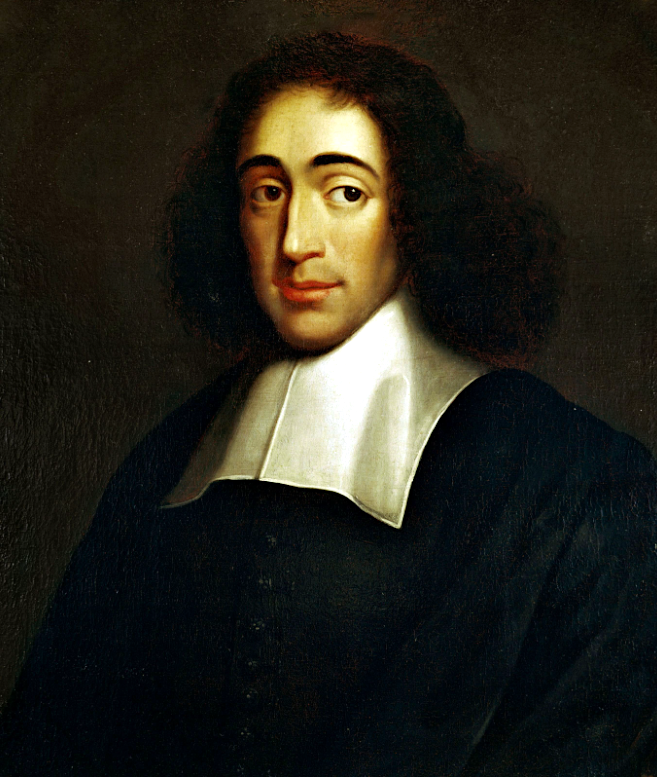
Featured image: Portrait of Baruch Spinoza, ca. 1665. Artist unknown. Herzog August Library, Wolfenbüttel, Germany.
Quotes taken from Benedict de Spinoza, Theological-Political Treatise, edited by Jonathan Israel, translated by Michael Silverthorne and Jonathan Israel, Cambridge Texts in the History of Philosophy, Cambridge University Press, 2007.
