
Today is Good Friday in the Christian world, a day that commemorates the execution of an innocent man because it was convenient for those who happened to hold political power. Mostly I’m going to write on The Moses Chronicles about biblical texts written in Hebrew, but to mark the day I’d like to share a reflection that ties one of my favorite Hebrew texts to the story of how Jesus prepared to die.
He came out and went, as was his custom, to the Mount of Olives; and the disciples followed him. When he reached the place, he said to them, “Pray that you may not come into the time of trial.” Then he withdrew from them about a stone’s throw, knelt down, and prayed, “Father, if you are willing, remove this cup from me; yet, not my will but yours be done.? Get up and pray that you may not come into the time of trial.”
— Luke 22:39–46
He didn’t want this.
But he knew it was coming. The flood. The destruction of the world as we know it. People will die. He would die.
That is some heady knowledge. When Noah is confronted with similar knowledge back in Genesis, he simply does what God tells him. Pretty simple, no hemming and hawing. Or at least this is the picture the Bible paints for us. But it’s hard not to want to fill in the gaps, to flesh out Noah’s character, make him more human. When we put our imagination to work, perhaps we get something that looks a lot like Jesus on the Mount of Olives. He knows that trouble is coming — deep trouble — and there is nothing he can do to make it stop. But he also doesn’t want to accept it.
Maybe the head is the wrong bodily metaphor, though. Maybe we should be thinking in terms of the stomach—the gut. We’ve all probably had to vomit at one time or another. You know that feeling. When you really, really, really want to avoid this highly unpleasant experience, but you know you can’t. It’s not even going to come on your timeline. You just have to wait for the inevitable and endure the agony in the meantime.
The disciples show us one way to navigate a moment like this. They go to sleep. We have all experienced this kind of moment in small or large ways, whether alone or together with family, friends, community. Perhaps your whole society. Maybe we already feel the trickles of a flood we cannot yet see. Or maybe we are looking toward the horizon and staring it right in the face, like Cassian Andor and Jyn Erso in Rogue One, about to be obliterated by the Death Star, whose destruction they have facilitated but not in time to save their own lives. The grief of such a moment is deep, overwhelming. It’s hard to get anything done. It’s hard to think straight. Why not just shut down? Turn it off and tune out. Think about something else, anything else, that will ease the pain.
But Jesus shows his disciples, and us, another way. He shows us that it’s okay to pray that the inevitable won’t come, or that it won’t affect us even if it does. “Father, if you are willing, remove this cup from me.” I don’t want it. This was not my plan. There is so much more I want to do in life. It is important that he is saying this prayer only a stone’s throw away from the disciples. It is a private, deeply personal prayer. But his friends can see him. And surely hear him. He is intentionally modeling for them what they should do. Not sleep. Get busy. It may not be time to act (yet), but the time is ripe to reflect. To pray.
What happens when Jesus prays? His prayer is deeply human, a natural expression of grief at the destruction that he (and we) can already see coming—perhaps not knowing or wanting to admit quite how bad it will get, but at the same time knowing, deep down in our guts, that it’s going to be bad. But he pairs it with acceptance. “Yet, not my will but yours be done.”
I don’t know about you, but I don’t believe for one second that he fully means this. He’s not ready. Nobody can be fully ready for the flood. Not even Noah, who was about as prepared as anyone could get. He had a boat, one that would give him a chance at survival. What Jesus shows us is that the space of reflection allows us to be ready even when we’re not. Even when no one can ever fully be ready. Space to see things clearly. To know what the right path is. To find the courage to choose it. His prayer gives him a vision of his fate—he sees in his own sweat the drops of blood that foreshadow what is about to happen. It gives him the strength to accept it. The courage to overcome the fear, the trauma, the anguish that surely remains with him to the end. Overcoming these things doesn’t mean they go away. It means that, in the eternal tussle between our angels and our devils, the devils don’t win.
Some might balk at this picture of Jesus. Might prefer a more heroic Jesus. A more divine Jesus. But this gets the balance wrong. Christians hold that Jesus is simultaneously fully divine and fully human. (How that trinitarian mystery works is something I’ll leave to the theologians…) Yet, even for the Christians among us, I think it is hard to grasp the significance of Jesus — who he was, what he did, how he lived, how he died — without (also) fully embracing his humanity. That he was just like us.
The historian Timothy Snyder, whose work is rightly getting a lot of attention these days, offers us some important perspective on heroes in Black Earth: The Holocaust as History and Warning. Much of this book deals with what can easily happen to individual morality when institutions fail. Stealing from neighbors. Profiting at their expense. Shooting them into pits. Near the end of the book, though, he talks about the people who acted in one way or another to save their Jewish neighbors, whose existence was threatened by those in power. We tend to think of these people as heroes — as individuals who did something that required extraordinary courage in the face of the flood.
Yet there is a danger in creating heroes, in perceiving them as fundamentally different from ourselves, as extraordinary where we are merely ordinary. Snyder shows us that this perception is simply not true. Testimony after testimony from these individuals whom we tend to place on a pedestal shows that they did not perceive themselves as doing anything extraordinary. They were as afraid, as terrorized, as mortified as anyone else at what was going on around them. But they were also clear-eyed, and, almost without thinking about it, they did what was simply obvious to them — what, in their view, was the only right thing to do.
They didn’t want the flood. Jesus didn’t want it. In moments like this, we don’t want it. But we know it is coming. Jesus tells his disciples, “Get up and pray that you may not come into the time of trial.” But he models for them and for us what it looks like to get ready for when the time of trial comes, so that they, and we, know what to do.
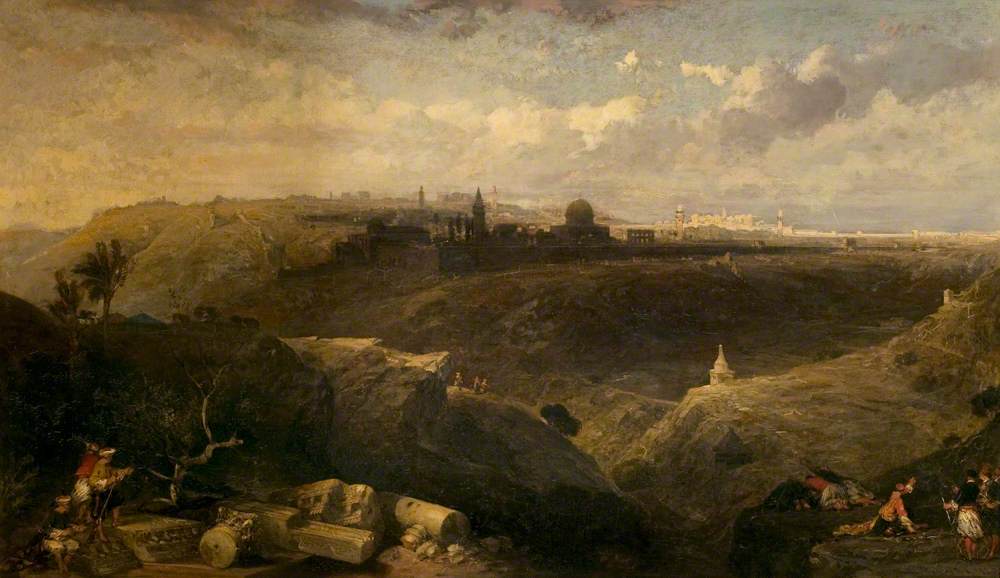
Featured image: David Roberts (1796–1864), Jerusalem from the Mount of Olives, Leicester Museums and Galleries
