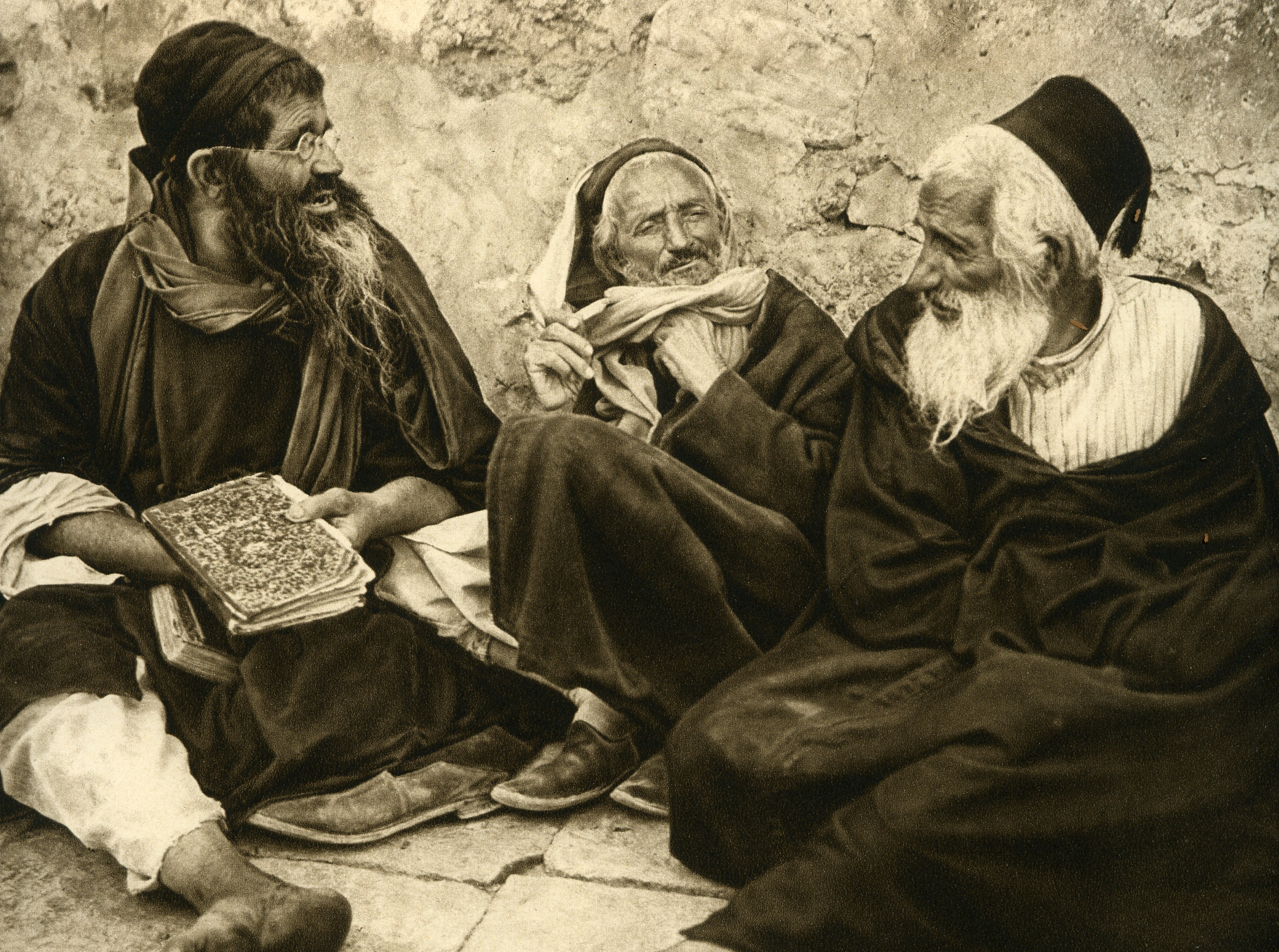

I love photographs. This one is from a much-loved volume of old photos of the Holy Land.1 It shows three men sitting next to the Western (Wailing) Wall in Jerusalem. I call it “My Torah Guys.” I don’t know if that’s really a Torah the guy on the left is holding (I doubt it…), but I like to imagine these three deeply immersed in a wonderful (and amusing) discussion about some biblical text. The guy on the left is going out on a limb with some new and nifty idea he came up with that morning. The guy on the right is listening with skepticism. See the look on his face? You can just imagine what he’s thinking: “Seriously. Come on now. You really expect me to believe that?!” My favorite is the guy in the middle. We’ll call him the lurker. He’s hanging out, having fun, maybe learning something. I can never decide if he’s amused or exasperated by the proceedings.
If, when you imagine what it looks like to read the Bible, you think of something more like this next image, you’re probably not alone.

Most of us probably imagine reading any book alone, perhaps in a dark room at home, maybe in bed. Even when we read in public — say, at a library — we are just sharing a room with other people doing the same thing (at least until we get up to chat with the others about what we’re reading…). This picture of the lonely reader is especially true of the Bible, which some of us read devotionally, to gain wisdom or knowledge of God that might shape our personal lives.
Yet we are never really reading alone. The Bible is the best-seller to beat all best-sellers.2 It has influenced art, literature (think John Milton’s Paradise Lost or William Faulkner’s Absolom, Absolom!), sermons and speeches (think Martin Luther King Jr.’s “I Have a Dream” speech), and various forms of public discourse. It has generated centuries of commentary in one form or another. We might call this a “stream of tradition.”3 Whether we like it or not — whether we’re aware of it or not — nobody comes to the Bible with a clean slate. The idea that we ever read with true independence is a kind of self-deception, a myth of freedom that is not real.
Timothy Snyder gives us a very useful way to understand this, as negative freedom, or freedom from — in this case, freedom from outside interference in what meaning we take from the text, in how it shapes us as human beings. This is between me and the Bible, right? Wrong. No amount of pretending will make those influences go away. What it will do is limit our understanding of the text, of ourselves, even of God. As Snyder puts it, “negative freedom is not a misunderstanding but a repressive idea. It is itself a barrier, a barrier of an intellectual and moral kind. It blocks us from seeing what we would need to be free” — free to read, and free to be.4
In fact, we read in community. All the people through centuries past who contributed to that stream of tradition are part of our community. So are the people we read with now, in a church, in a synagogue, in a book club. You are here, in conversation with me and potentially others who are also here, reading and learning together. We are building community.
It matters how we imagine that community. Here’s one way:

In this way of thinking about community, some people get to tell the rest of us what the Bible means. We see the consequences in this picture. A couple of them are rapt, but the others look bored, tired, dour, or busy with something else. Even the man himself looks weary. No one seems happy. Or free.
Bad ideas about community — including the idea that we can ever be free from it — are costly. They keep us from seeing the world, ourselves, and even God clearly. They make us unfree. Snyder offers us a positive vision of freedom, freedom to instead of freedom from, one that can only be realized in relationship with others.
This is a very different way of thinking about community. A more honest and fruitful one. It is mutual, cooperative. Everyone brings something to a reading of the Bible, drawing from our own experience and knowledge. (Yes, some of us have more than others, but insights can come from anywhere, and fresh eyes are just as important as experienced ones…) It is open, curious. No one person controls the outcome or shuts down the process of discovery. To control is to impose the kind of barriers Snyder talks about, to limit our freedom to better understand the Bible, ourselves, and the world in which we live.
Here’s a little exercise to help you understand what I mean. Rearrange in your mind the elements of Greuze’s Reading the Bible. Put the Bible in the middle of the table. Imagine everyone gathered around it. Maybe even mix up the men and the women, the young and the old. Some are looking at the text, some are talking to each other. All are engaged. Okay, maybe not the toddler, who is surely still playing with the dog…
What you get is my Torah guys. That photograph illustrates one of the things I value most and want to encourage you to value as well: impassioned discussion about important (and maybe some not-so-important) things, carried out with seriousness, but also a sense of humor. That’s what we are going to do here at The Moses Chronicles, and I invite you to the conversation as you are, free to be, free to learn, free to become. You see the personalities of my Torah guys coming through brilliantly in this picture, and I am certain they are friends.
- Karl Groeber, Picturesque Palestine: Arabia and Syria (Brentano’s, 1925), 58. ↩︎
- Guiness World Records, “Best Selling Book.” ↩︎
- This term was coined by A. Leo Oppenheim in his classic Ancient Mesopotamia: Portrait of A Dead Civilization, rev. ed. (1977 [1964]) to capture the idea of a body of writing that was copied over a long period of time and tapped to create new writing that itself became part of the stream. It is a way of talking about our indebtedness to the past we inherit, even when we create something new. ↩︎
- Timothy Snyder, On Freedom (Crown, 2024), 23. ↩︎
